
How much exercise for longevity? A research-based answer
Bryan Johnson works out every day and shares his data for us regular folks. We have work, meal prep, kids, and weeks when squeezing out 45 minutes ends in a nap from exhaustion.
So I went looking for what the research says you get at each amount of time. I wanted the numbers for a real week, the kind where two sessions get eaten by a work trip and you do the third in a hotel gym with dumbbells that stop at 20 pounds.
This breakdown covers what studies measured at four minutes a day, one or two days a week, and up to four hours split between lifting and cardio.
If you only have 4 minutes a day
Researchers put wearables on about 25,000 adults in the UK Biobank who did no formal exercise at all, then watched what happened over roughly seven years.
The thing they measured was short bursts of hard effort baked into normal life: carrying groceries up stairs fast, walking uphill to catch a bus, or one or two minutes at a time about three times a day, around four minutes total.
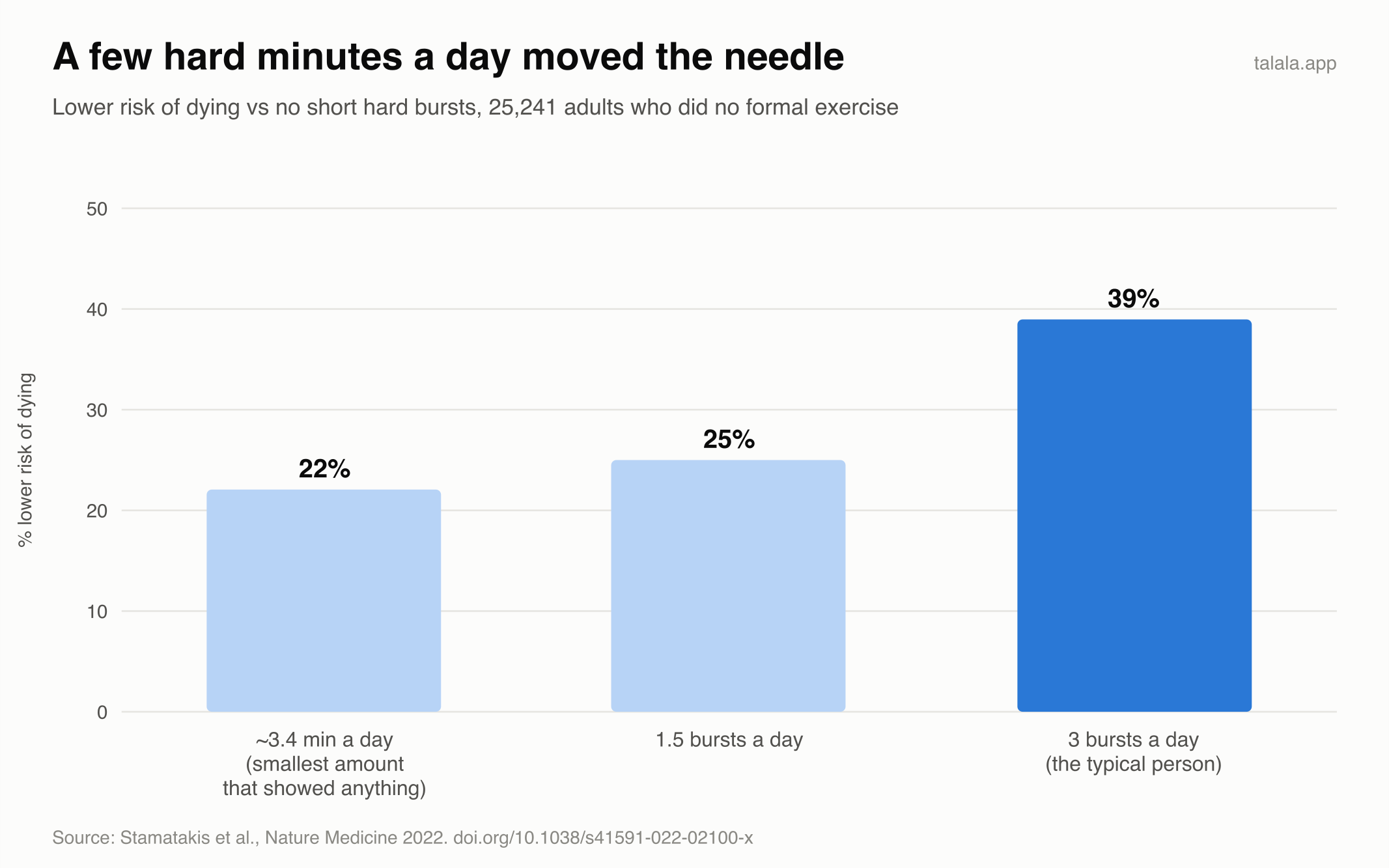
Three short bursts a day came with a 38 to 40 percent lower risk of dying during the study compared with people who did none of it. Even the smallest amount that showed anything, about three and a half minutes a day, came with around 22 percent lower.
Source: https://www.nature.com/articles/s41591-022-02100-x
How to fit short bursts into a normal day
What I do, three times most days: find a moment that already involves going up or moving fast. A staircase, the hill up from the parking lot, or the walk to the bus stop when you are already late.
Go hard enough for about a minute that talking would be awkward. Repeat it twice more before the day is over.
I read the paper on my phone and then took the stairs at the office instead of the elevator.
Can you fit exercise into one or two days a week?
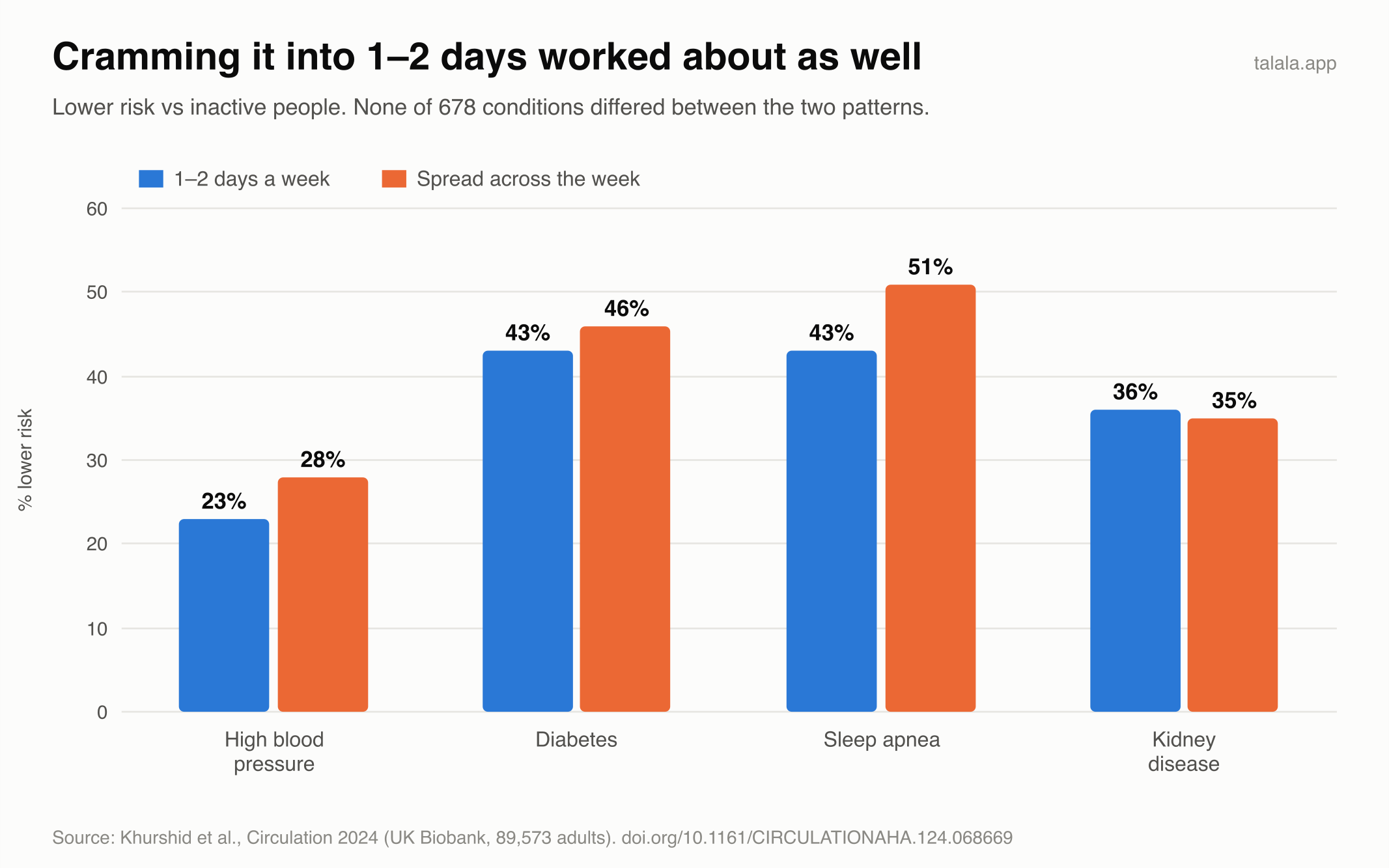
It took me a while to believe this one. Researchers looked at about 89,000 people in the UK Biobank and compared two groups who both hit the standard activity guidelines. One spread it across the week. The other crammed it into one or two days.
They checked 678 different conditions. There was not a single one where cramming did worse. Diabetes, high blood pressure, sleep apnea, all of it tracked about the same either way.
Source: https://www.ahajournals.org/doi/10.1161/CIRCULATIONAHA.124.068669
How I would set up a two-day week
Pick the two windows you actually get. Mine would be Saturday morning and one weekday evening.
Put a 45-minute strength session in each one. Add a long walk or an easy bike ride onto whichever day has more room.
Add the minutes up. If the two days come to about 150, you are at the guideline the study was measuring.
My friend Erin does everything on Saturday. I used to think she was doing a worse version of what I was doing. Turns out she was fine.
How much exercise per week for longevity? About 2.5 hours
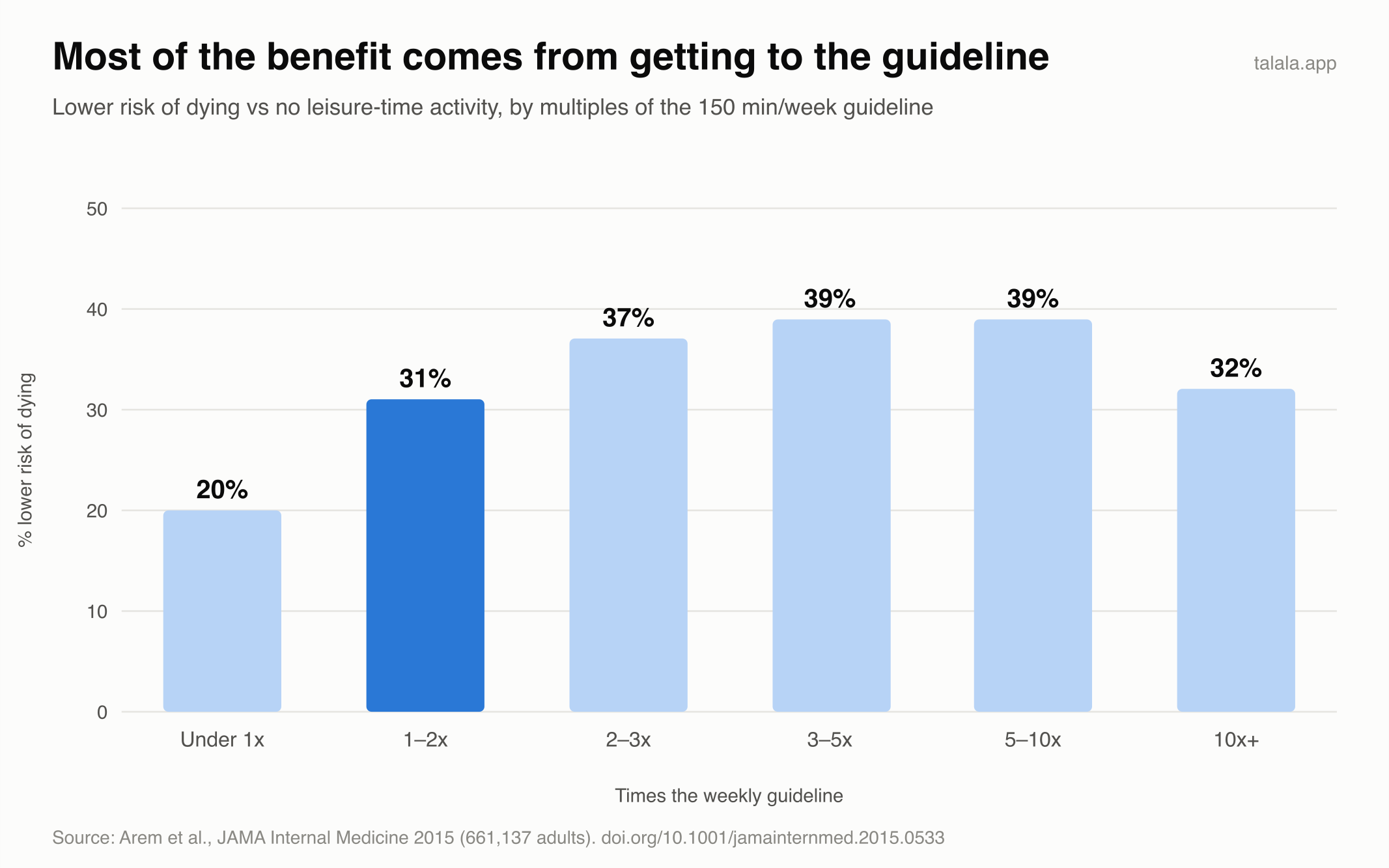
Every health agency prints this number. A pooled analysis of more than half a million adults in the US and Europe found that hitting one to two times the recommended minimum came with about a 31 percent lower risk of dying compared with doing no leisure-time activity at all.
Source: https://www.cancer.gov/news-events/press-releases/2015/peak-longevity-physical-activity
- Three 50-minute sessions, or a 30-minute walk five days a week plus one longer workout.
- Keep the effort where you can talk but could not sing. That is what moderate means.
- Count the walk to the train and the dog loop. They are the same minutes.
What changes if you have 7 hours a week?
I expected the graph to keep climbing here. In the same study, people doing three to five times the minimum, roughly seven to twelve hours a week, got to about 39 percent. Better than 31, definitely. But going from 2.5 hours to 7 hours a week bought less than getting off zero did.
At ten times the minimum it was still about 32 percent lower. No sign of harm, which is the part I had been worried about.
How I would spend the extra hours
Keep the two hard sessions exactly where they are. Make everything on top of them easy: walking, cycling, or a Saturday hike with someone slower than you.
Around seven hours is where I stopped adding, because that is where the line goes flat. I spent about two years assuming my problem was volume. It was not.
How much strength training supports longevity?
Three cohorts, nearly 150,000 health professionals, followed for about 30 years. They tracked strength training separately from cardio and looked for the dose that mattered.
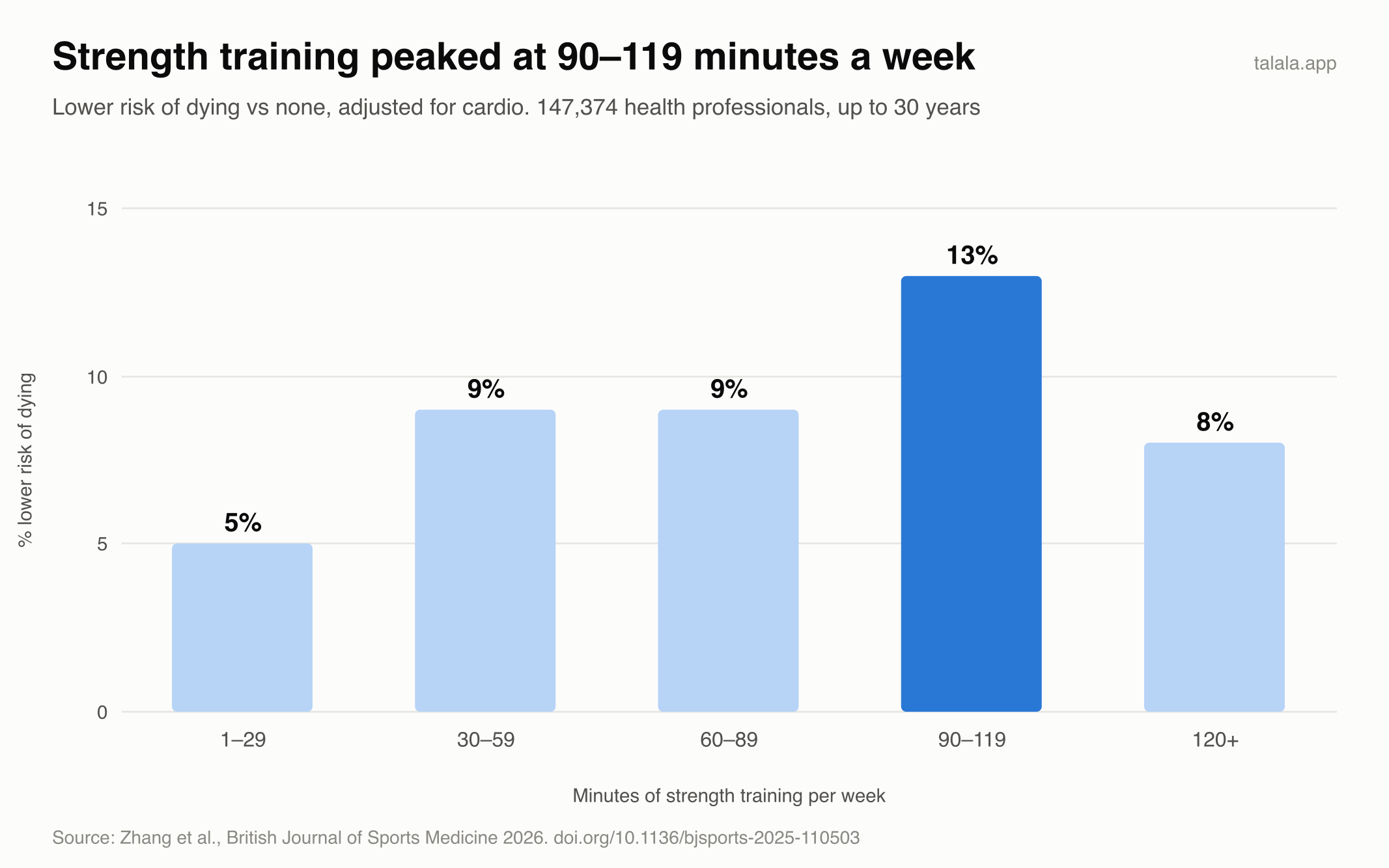
Ninety to 119 minutes a week came with a 13 percent lower risk of dying, 19 percent for heart-related deaths, and 27 percent for neurological ones. Above 120 minutes a week, nothing extra showed up for overall mortality.
Source: https://doi.org/10.1136/bjsports-2025-110503
What to put in two 45-minute strength sessions
Two sessions, 45 minutes each, at least two days apart. In each one, cover four shapes: a push, a pull, a squat or lunge, and a hinge like a deadlift or a hip thrust.
Do three sets of each, six to twelve reps, stopping when a rep gets slow. Add a little weight the next week if the last rep still felt doable.
That is the whole strength prescription, and it fits in the gym block I already have. Which of your muscles those 90 minutes should go to is a different question, and it is the one I would actually spend time on. See where you stand for your age, muscle by muscle, and work backwards from there: https://go.talala.app/m
What if you have 4 hours to split between lifting and cardio?
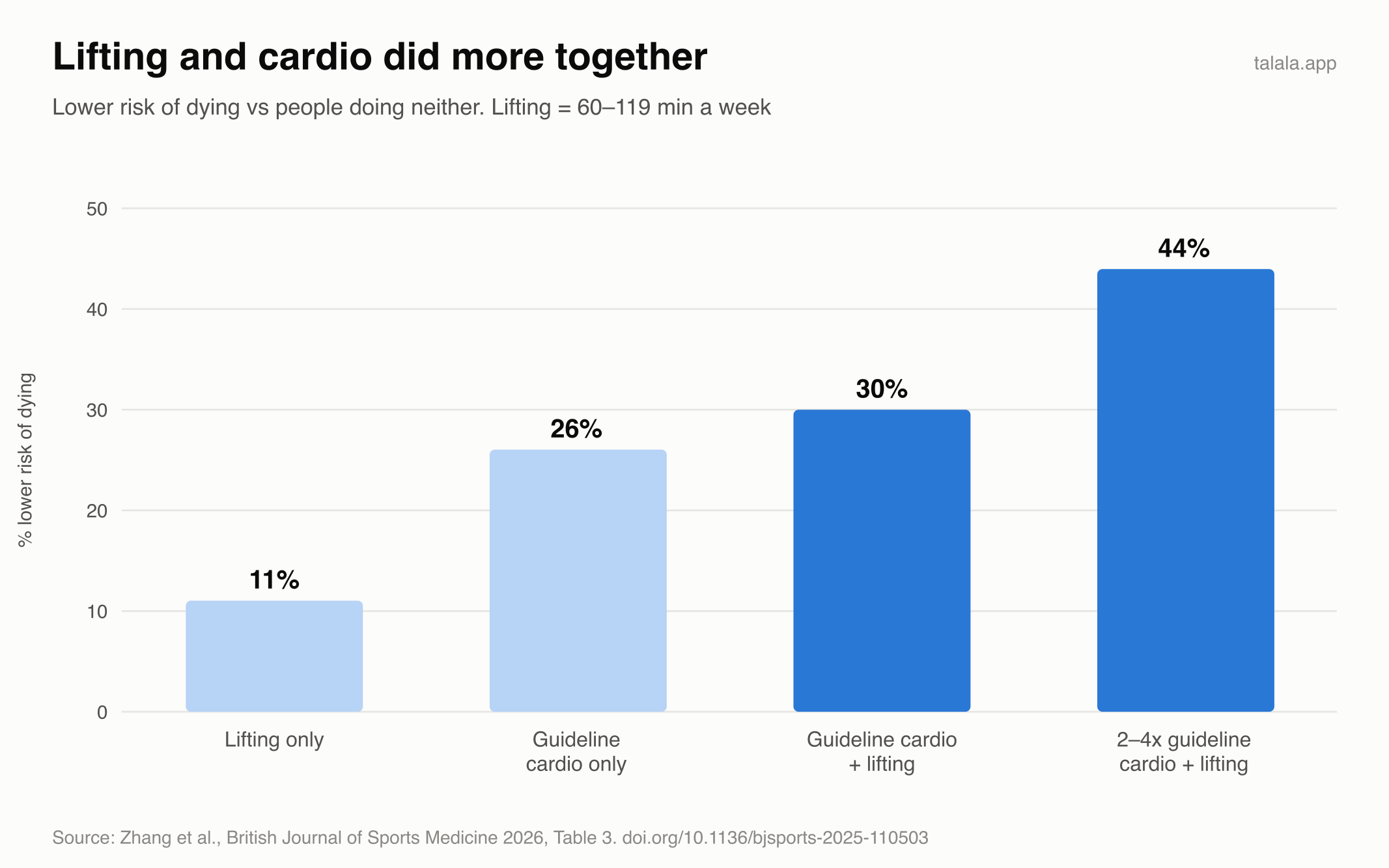
In that same 150,000-person study, they also crossed the two habits. Lifting 60 to 119 minutes a week on its own came with about 11 percent lower risk of dying than doing neither. The guideline amount of cardio on its own came with 26 percent lower. Both together got to 30 percent, and with a bit more cardio on top of the lifting it reached 44 percent.
How I would carve up four hours
Block 90 minutes of lifting first, in two sessions. Fill the other two and a half hours with walking fast, cycling, or whatever you will actually do.
On a week that falls apart, keep the two lifting sessions and let the cardio go. I moved one of my running days to the garage rack about six months ago. It was the Tuesday one, which I had been running since before my kid was born.
Note: this is not medical advice. If something hurts or you are postpartum, check with a doctor or physio first.
What should your 90 minutes of strength training focus on?
The harder part is knowing which muscles are actually behind, so the two sessions you can afford go where they will do the most. Talala measures that from the sets you already log: https://go.talala.app/m
A strength map of every muscle, built from your own lifts. Your strength age, scored against people your age and sex. Workouts that steer toward whatever is catching up.
Try Talala now on the App Store. Longevity workouts shaped by your every measured muscle: https://go.talala.app/m
It is time to meet your personal trainer who shapes each workout uniquely to you.
Longevity workouts shaped by your every measured muscle.
Talala estimates your strength map from your own logged sets, then builds every workout to close the gaps it finds. You finally know how to improve instead of following someone else's plan.