
What happened at Hyrox Beijing?
It was Hyrox Beijing on September 12, indoors at the National Speed Skating Oval. Joanna Wietrzyk was racing the women's pro division. Around the burpee broad jumps, she lost control of her bowels. She didn't stop. She finished the rest of the stations and won in 1:01:23, 45 seconds ahead of the reigning world champion, Alyssa McElheny.
Everyone behind her still had to deal with it. Officials closed off some areas and pulled some of the equipment, but other athletes still raced the same track and used the same gear. Some of them reportedly slipped. The venue had to be disinfected afterwards and the carpet replaced.
Who is Joanna Wietrzyk?
If you don't follow Hyrox closely, she's kind of a big deal. She's Australian, born in Melbourne in 2002, and she holds the women's pro world record, 54:25, set in Warsaw this April. Last season she won all four Elite 15 Majors and came second at Worlds. She's run a 2:52 marathon, and before any of this she played tennis at a national level and netball at a state level.
She's one of the best-trained women in the sport, and it still happened to her.
Why did the response to the race draw criticism?
Right after the race, while she was hooked up to an IV, she posted "Go hard or go home... a win is a win." She deleted it later, but people had already screenshotted it, and that's the part most people were angry about.
A few days later she apologized. She said she felt completely fit and healthy at the start, with no reason to expect any illness, and wrote, "I am genuinely sorry to everyone who was affected." Then she said she was withdrawing from the result and giving up the win and her points. (As I'm writing this, the official results still list her first.)
Her coach, Chris Bayens, spoke up for her against the personal attacks, and Hyrox said it'll ban people who send her abuse. Which, thank god.
Why can gut symptoms happen during hard exercise?
We only know the public story, and she hasn't said what caused it, so I'm not going to guess about her body. But guts give out mid-race on trained athletes way more than anyone talks about.
I read a sports-science review that walks through it. When you go all-out, your body sends blood to your legs and lungs and away from your gut. Stress hormones tighten the gut's blood vessels on top of that, and running bounces everything around. Being dehydrated, taking painkillers like ibuprofen, and eating something new on race day all make it more likely. [Sports-science review](https://www.gssiweb.org/sports-science-exchange/article/sse-114-nutritional-recommendations-to-avoid-gastrointestinal-distress-during-exercise).
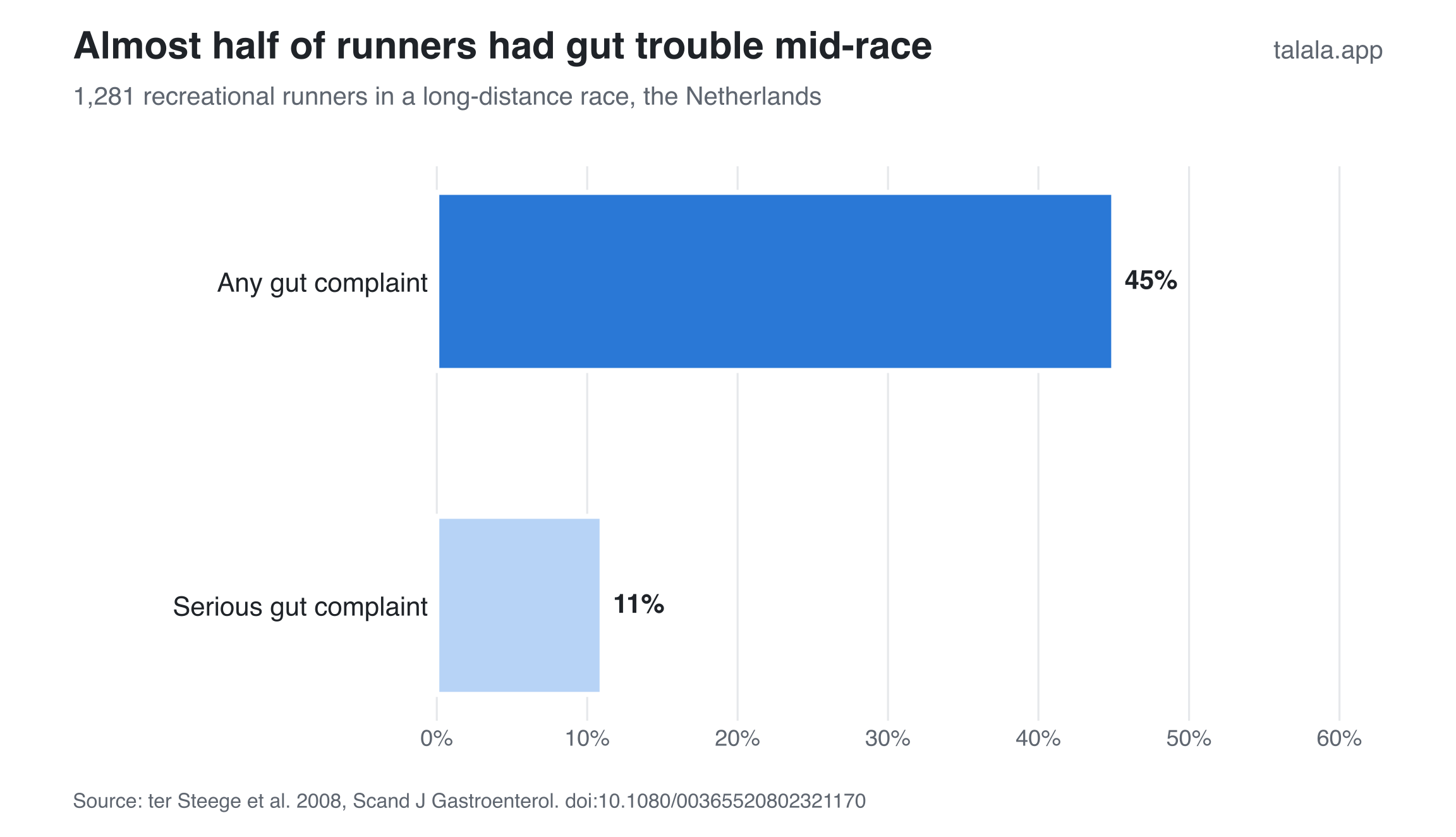
The numbers surprised me. In a Dutch study of 1,281 runners after a long-distance race, 45% had at least one gut complaint while running, and 11% had serious ones. The serious ones were more common in women, in younger runners, and in people who weren't used to drinking during a run. [Dutch runners study](https://doi.org/10.1080/00365520802321170).
How common are serious gut symptoms in endurance events?
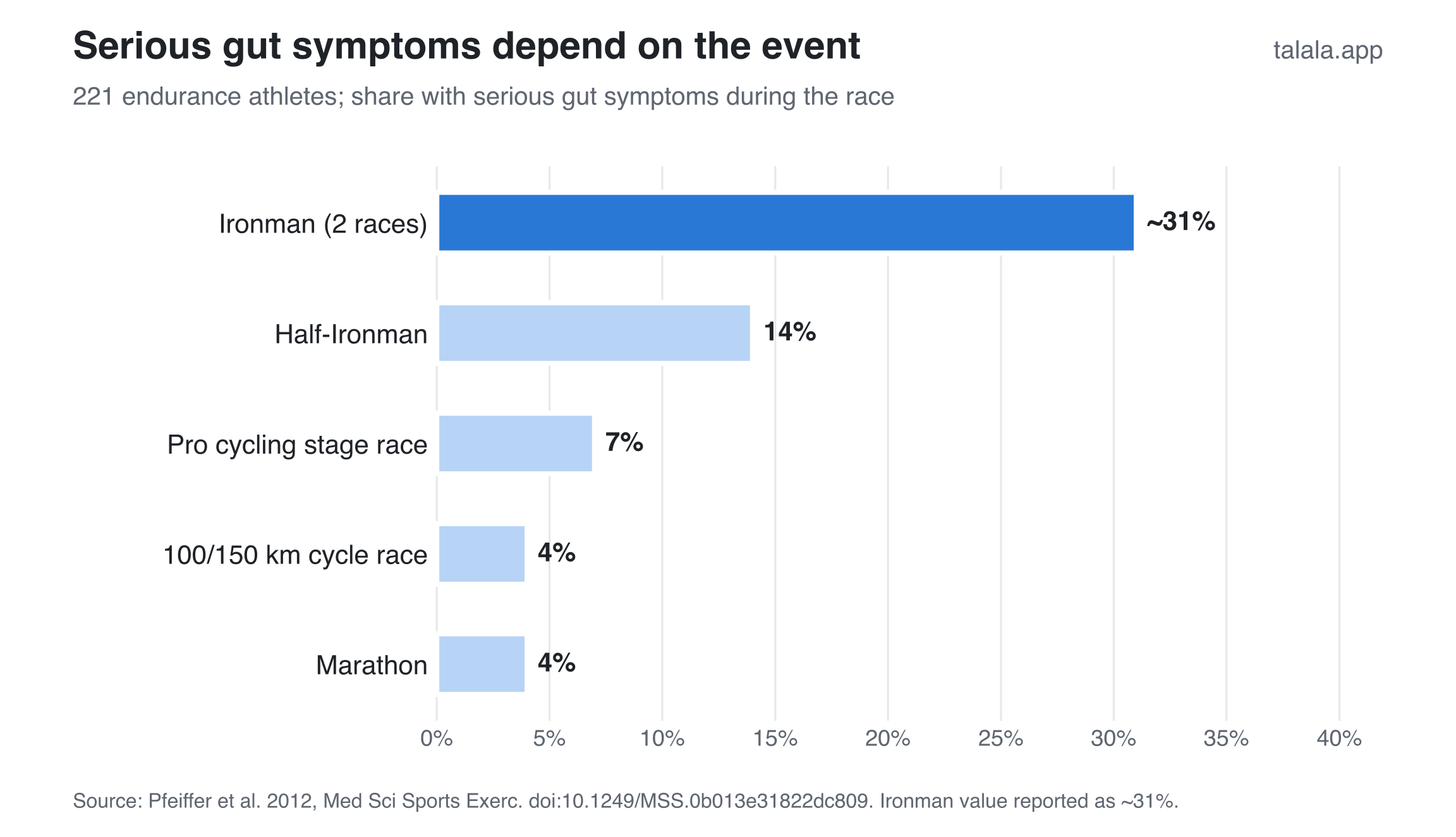
It also depends a lot on the event. A study of 221 endurance athletes found serious gut symptoms in about 31% of Ironman racers, 14% at half-Ironman, and 4% of marathoners. People who'd had gut trouble before were more likely to have it again. [Study of 221 endurance athletes](https://doi.org/10.1249/MSS.0b013e31822dc809).
Where should we draw the line on pushing through?
Hyrox isn't an Ironman, but an hour of flat-out running between sled pushes, burpees, and wall balls is still really rough on your stomach.
Most of us grew up on those push-through clips, like the runner crawling across the finish line, and I love them too.
I keep thinking about the women racing behind her, who didn't get any say and still had to run on that same track.
I'm not racing for a world title, but I do the same thing on a smaller scale. A lot of my own push-through moments were really me not wanting to look like I quit. Now if I've slept three hours or my stomach feels off, I just go lighter.
When I'm not sure how hard to push, I'd rather have an AI coach walking me through the session than guess.
What changed after Hyrox Beijing?
Co-founder Moritz Fürste said Hyrox "made a mistake by not reacting immediately during the race." The new rule lets race directors pull an athlete when blood, vomit, urine, or feces creates a contamination risk.
I think that's the right fix. It takes the decision away from an exhausted 24-year-old halfway through a race she's winning. I can't think straight when I'm totally redlining, so I'm glad it's someone else's call now.
Is Hyrox training good for longevity?
After all of this, I wanted to know if this kind of training is actually good for you long term.
Since Hyrox is a new phenomenon, we have yet to discover its impact on health in the long run. There's a ton of data on cardio and strength work though, and that's basically all Hyrox is.
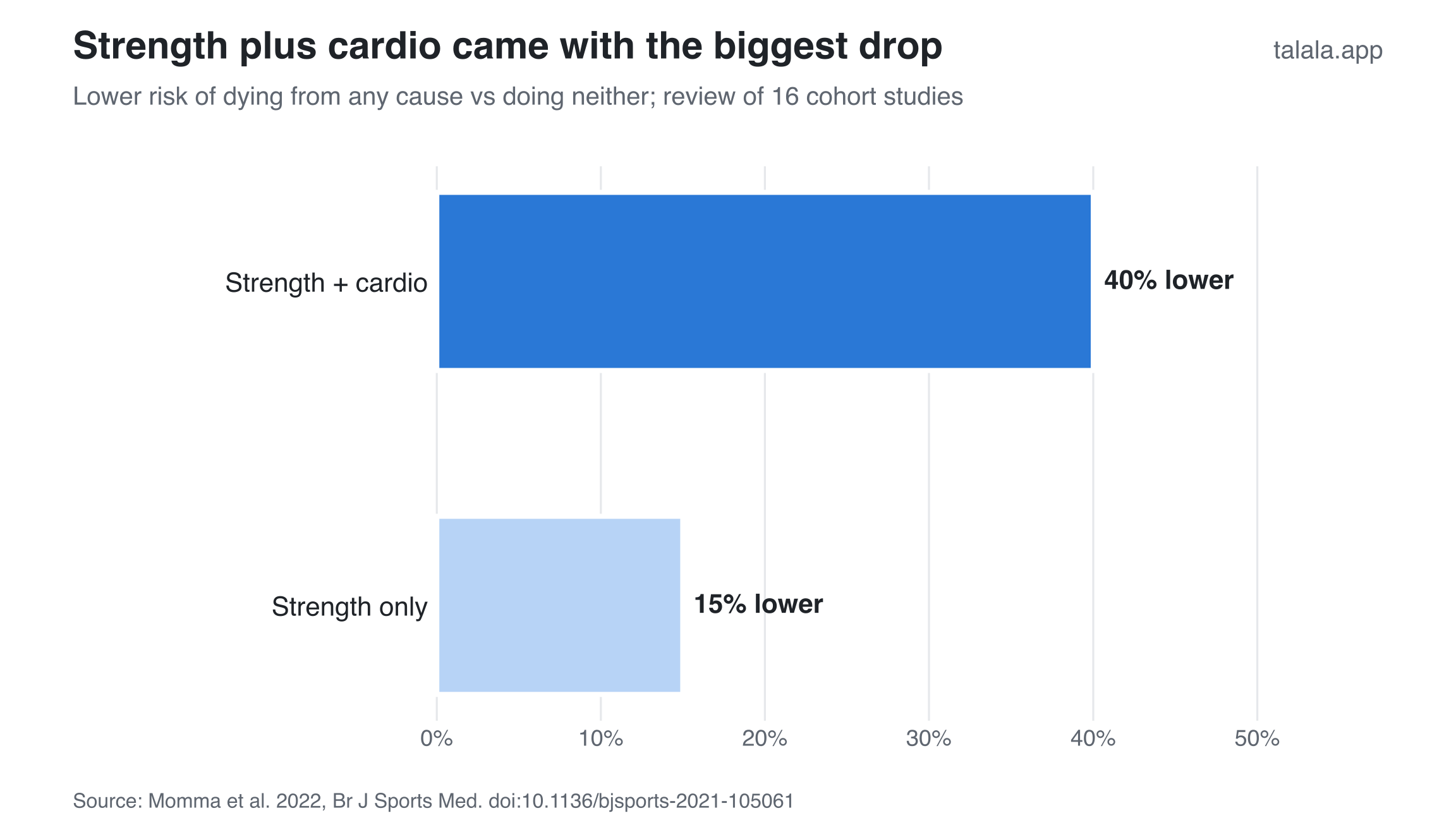
A 2022 review of 16 studies found that people who did strength training had a 15% lower risk of dying from any cause during the studies than people who did none. People who did strength training and cardio together had a 40% lower risk. [2022 review](https://doi.org/10.1136/bjsports-2021-105061).
How much exercise is linked with lower risk?
For strength work alone, the biggest drop in that review was at around 30 to 60 minutes a week, and after about 140 minutes they couldn't tell if more still helped.
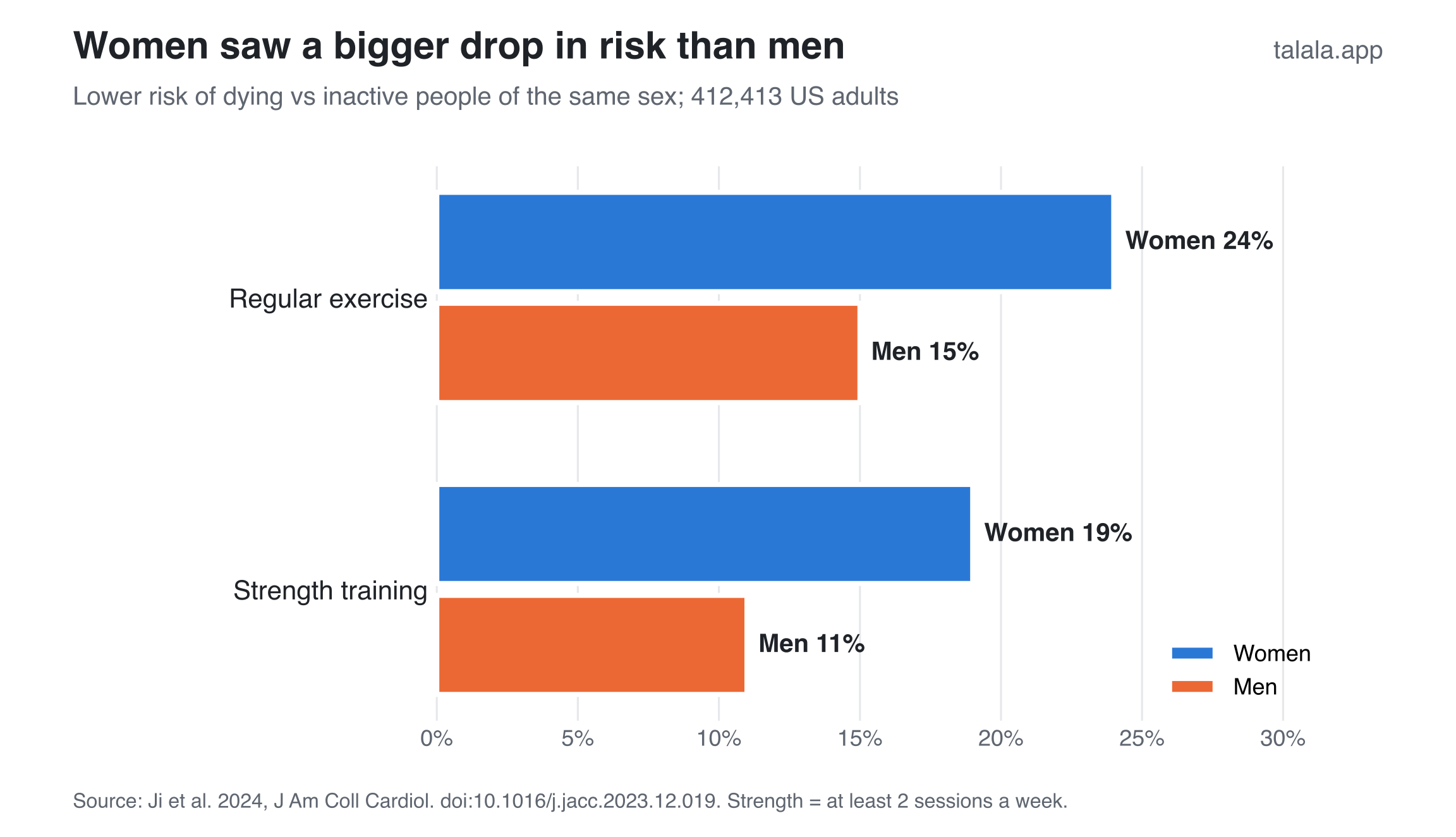
I got kind of happy reading a study of more than 400,000 US adults, because women who exercised regularly had a 24% lower risk of dying during the study than inactive women, and men had 15%. Women who did strength training at least twice a week had a 19% lower risk, and men had 11%. Women also saw the same lower risk at 57 minutes of vigorous exercise a week that men saw at 110. [Study of more than 400,000 US adults](https://doi.org/10.1016/j.jacc.2023.12.019).
What does the first Hyrox study tell us?
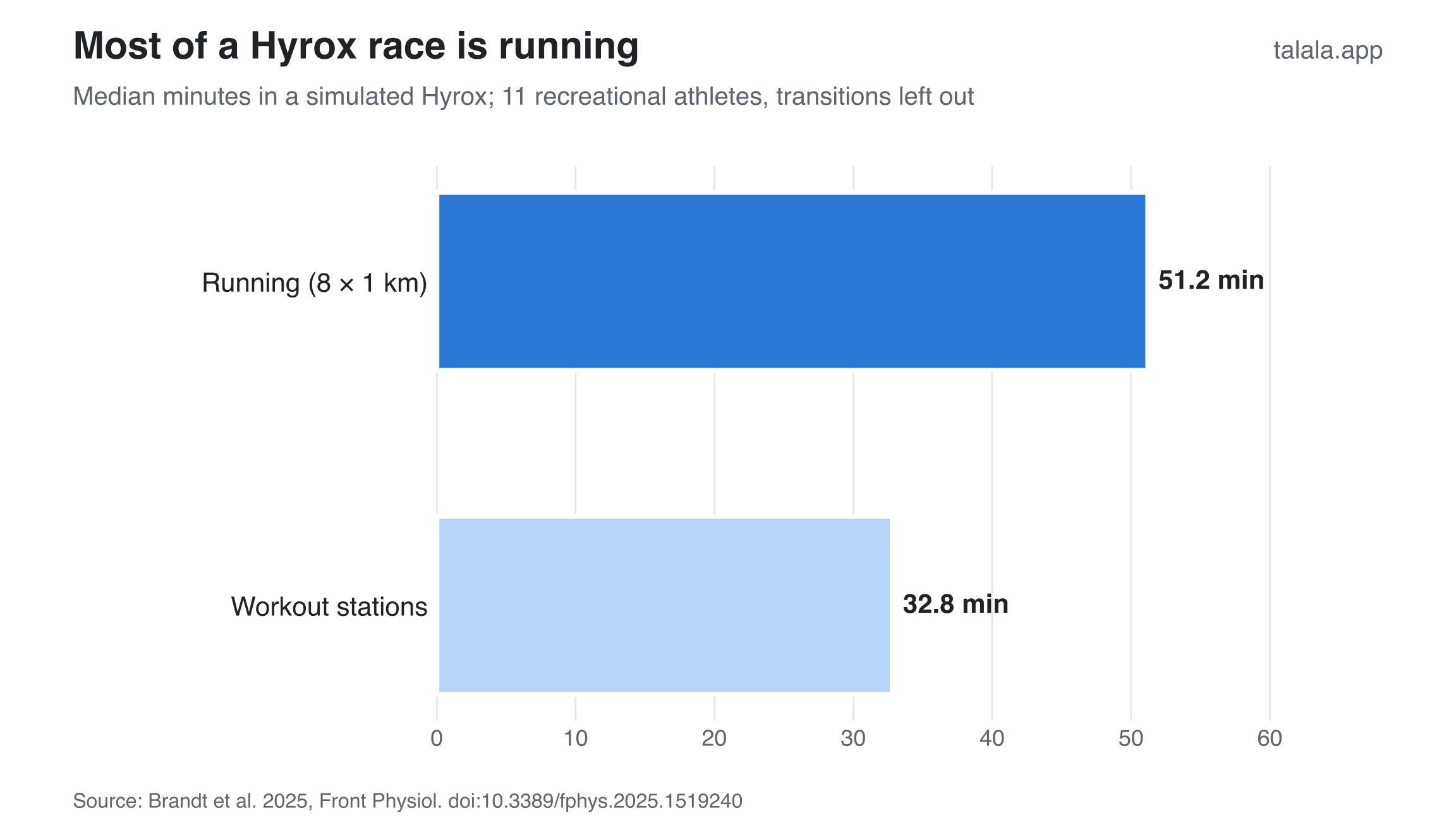
Hyrox is mostly the cardio part. In the first study on Hyrox, 11 recreational racers spent about 60% of a simulated race running, and about 80% of the whole race was at 90 to 100% of max heart rate. The researchers think this kind of training could be an efficient way to hit the WHO's exercise guidelines, but they also say its health benefits still need to be tested. [First study on Hyrox](https://doi.org/10.3389/fphys.2025.1519240).
What can we take from Hyrox and longevity research?
So the two things Hyrox is made of are linked to a lot less risk, even though Hyrox itself hasn't been studied that way yet. And the strength numbers peaked at pretty normal amounts, like half an hour to an hour a week.
Your gym workout, now a personalized class
Made by women, made for longevity, backed by science
Get a science-backed longevity personalized workout plan. AI coach led workout sessions, never feel confused about the gym again. A Strength Map of every muscle, measured from your own sets.
Try Talala now on the App Store. Longevity workouts shaped by your every measured muscle. https://go.talala.app/m
It's time to meet your personal trainer who shapes each workout uniquely to you
A note on exercise and health
Note: this isn't medical advice. If something hurts or you're postpartum, check with a doctor or physio first.
Longevity workouts shaped by your every measured muscle.
Talala estimates your strength map from your own logged sets, then builds every workout to close the gaps it finds. You finally know how to improve instead of following someone else's plan.