Why is the protein calculator number a floor?
The official protein number is the same for a 25-year-old and an 80-year-old.
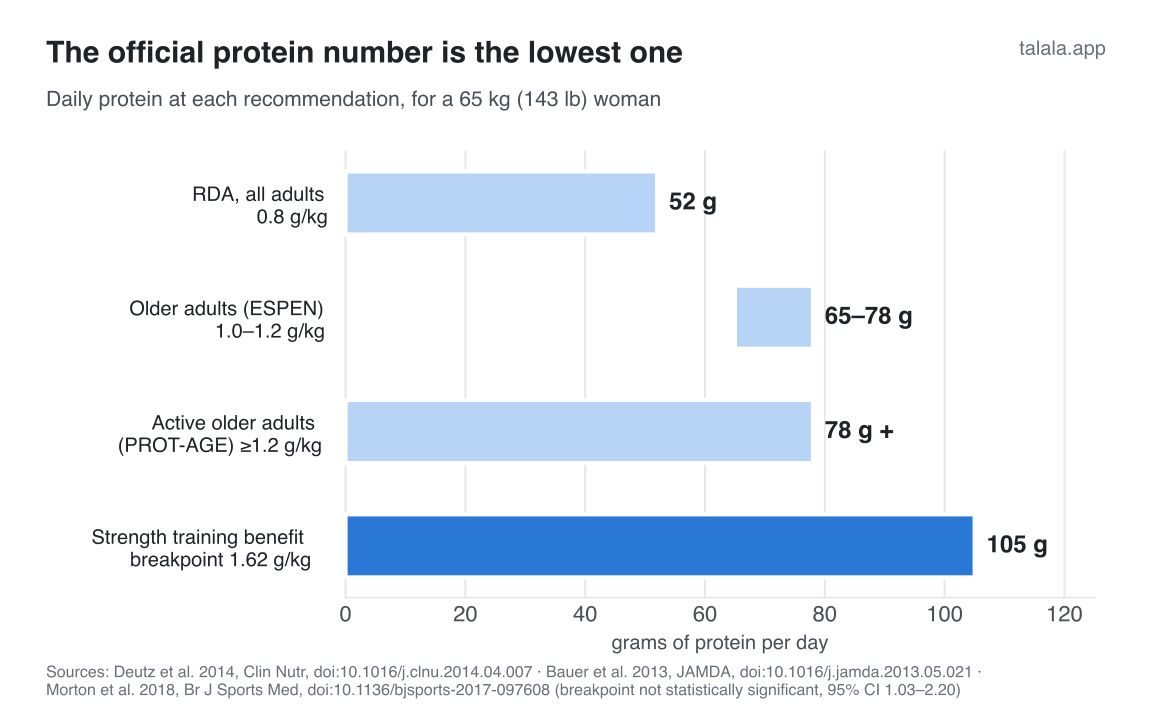
It's 0.8 grams per kilogram of body weight a day, and it's been set that way for healthy adults of every age (Deutz et al., 2014 [https://doi.org/10.1016/j.clnu.2014.04.007]). For me that's about 52 grams. I hit that by lunch most days and for years I figured I was done.
Then I started lifting seriously in my 30s, got curious, and found out that number's basically the minimum so you don't come up short. So here's the number I go by now, why it creeps up as you get older, and how I actually eat it without counting every bite.
How much protein after 40 should you aim for?
When a group of European nutrition experts looked at older adults, they recommended 1.0 to 1.2 grams per kilogram for people over 65 (Deutz et al., 2014 [https://doi.org/10.1016/j.clnu.2014.04.007]). Another group said at least 1.2 for older adults who are active (Bauer et al., 2013 [https://doi.org/10.1016/j.jamda.2013.05.021]). A big 2018 review of 49 trials on protein and strength training found the benefit kept climbing up to about 1.6 grams per kilogram (Morton et al., 2018 [https://doi.org/10.1136/bjsports-2017-097608]).
How should you interpret the strength-training protein target?
Okay, one thing about that 1.6. The researchers' own math wasn't statistically certain about where the benefit tops out, and the range around it ran from about 1.0 all the way to 2.2. They suggested about 2.2 grams per kilogram for anyone who wants to be sure they're getting the most from their training.
So when our protein calculator [https://www.talala.app/resources/protein-calculator] gives you a number, I'd treat it as where you start. For people who lift, the research I read points higher.
Why do protein needs rise with age?
As we get older, the same meal sends a weaker "build muscle" signal than it used to. Researchers call it anabolic resistance (Deutz et al., 2014 [https://doi.org/10.1016/j.clnu.2014.04.007]).
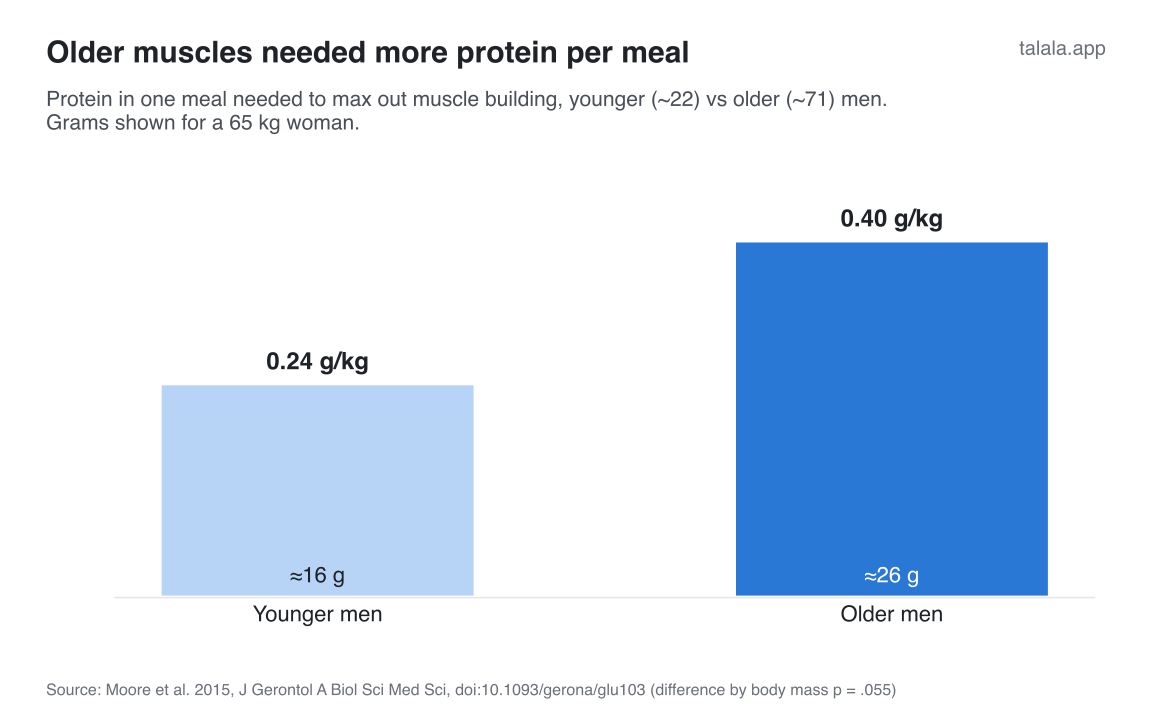
The clearest number I found on this comes from a study pooling older men (around 71) and younger men (around 22). The younger men maxed out their muscle-building response at about 0.24 grams of protein per kilogram in one meal. The older men needed about 0.40 (Moore et al., 2015 [https://doi.org/10.1093/gerona/glu103]).
What does the per-meal evidence mean for women?
It's all men, and the gap was borderline in their stats. But for a 65-kilogram woman, that's the difference between about 16 grams and 26 grams in a meal. My old breakfast of a banana and a coffee wasn't close to either.
What happens to lean mass during the menopause transition?
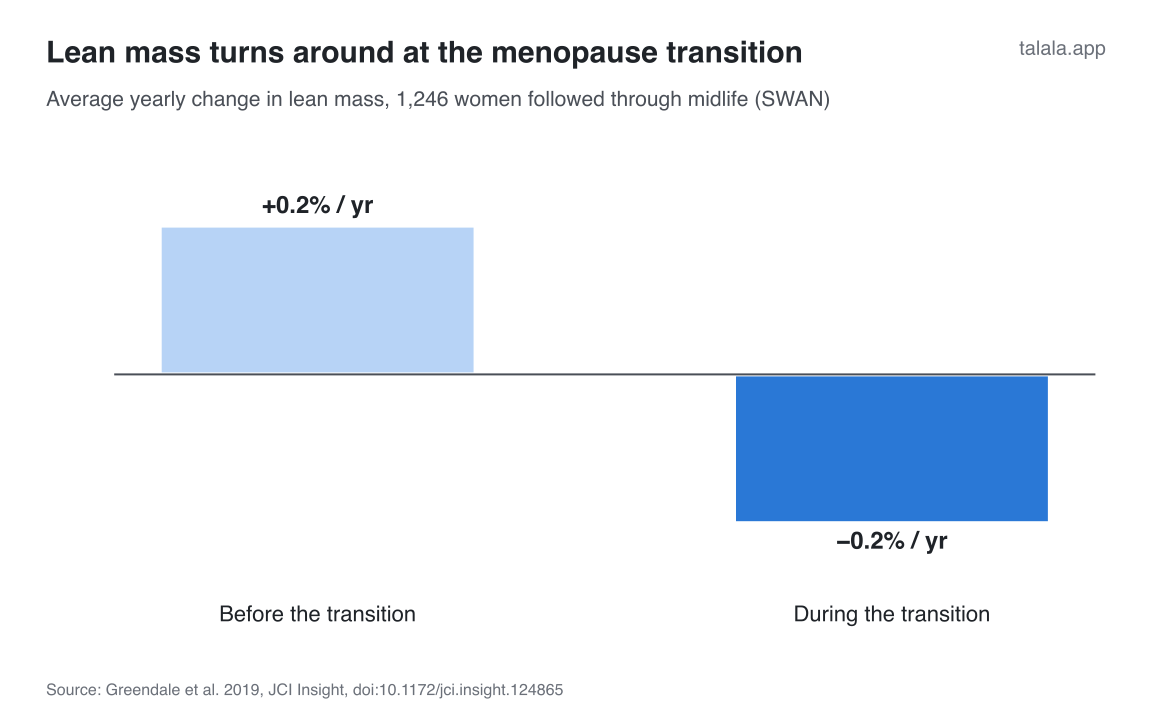
This one got my attention. A study that followed 1,246 women through their 40s and 50s found that lean mass was still inching up, about 0.2% a year, before the menopause transition started. During the transition it turned around and went down by about the same amount each year (Greendale et al., 2019 [https://doi.org/10.1172/jci.insight.124865]).
How large was the lean-mass change?
The total drop was small, about 0.2 kg across the whole transition. I find that reassuring. It's a small, slow change, and it's kind of why I want to be lifting and eating enough protein while it happens.
How should you spread protein across meals?
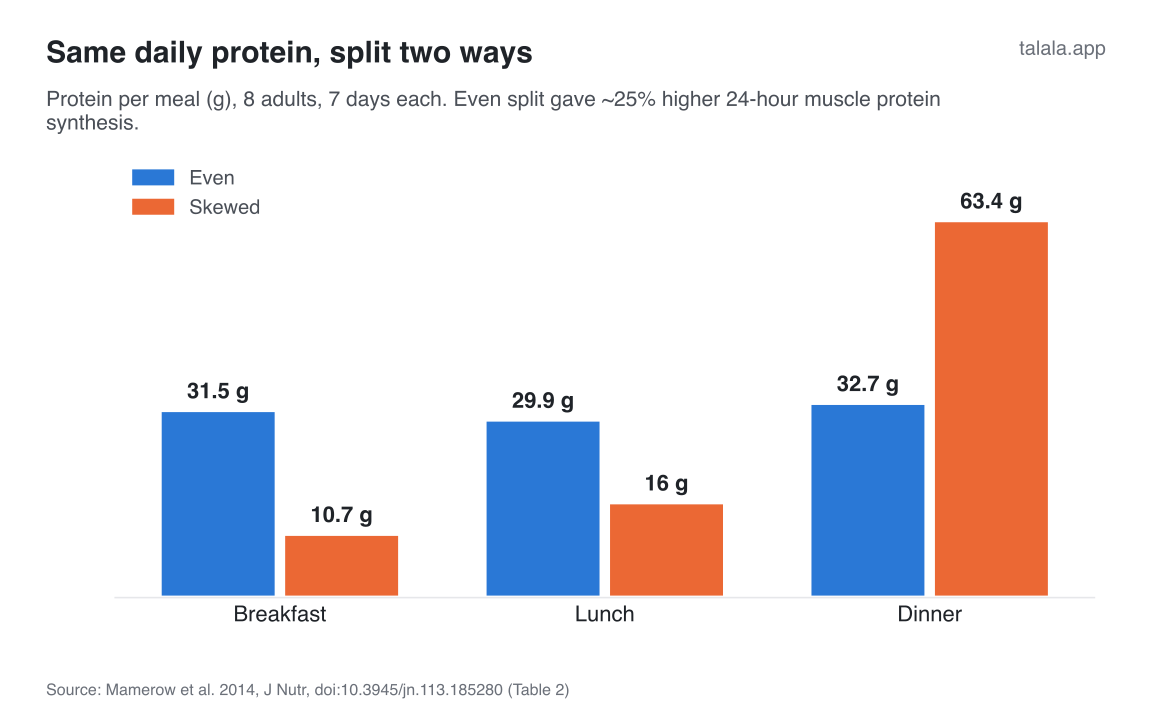
The easiest change I made was spreading protein across the day. In a small study, eight adults ate about the same total protein two ways for a week: evenly across three meals (around 30 grams each), or skewed, with about 11 grams at breakfast and 63 at dinner. Muscle building over 24 hours was about 25% higher with the even split (Mamerow et al., 2014 [https://doi.org/10.3945/jn.113.185280]).
What can a small meal-timing study tell us?
Eight people is tiny, and it only measured muscle building over one day, so who knows about actual muscle. But it matched something I'd noticed about myself, which is that dinner was doing all the work. If you want the timing side of this, I wrote about it in Protein Timing: What Actually Matters? [https://www.talala.app/blog/protein-timing-what-actually-matters]
What does 1.2 to 1.6 grams per kilogram look like in a day?
I aim for about 1.2 to 1.6 grams per kilogram and roughly 25 to 30 grams at each meal. On a normal day that's Greek yogurt with granola at breakfast, a big chicken salad from the Whole Foods hot bar at lunch, and whatever's for dinner with a real portion of protein on the plate.
Protein doesn't do much for me if I'm not lifting, though. I check where I stand for my age, muscle by muscle [https://go.talala.app/m] every month or so, and it's the only way I'd know if all that yogurt is doing anything.
Note: this isn't medical advice. If you have kidney disease or your doctor has you on a protein limit, check with them before eating more.
Talala is where your plan is only yours
Made by women, made for you, backed by science
- Get a workout plan built around your goals
- AI coach led workout sessions, never feel confused about the gym again
- A Strength Map of every muscle, measured from your own sets
Meet your personal trainer: every workout planned for you, and coached in your ear. Download Talala on the App Store