Do women get less creatine from food?
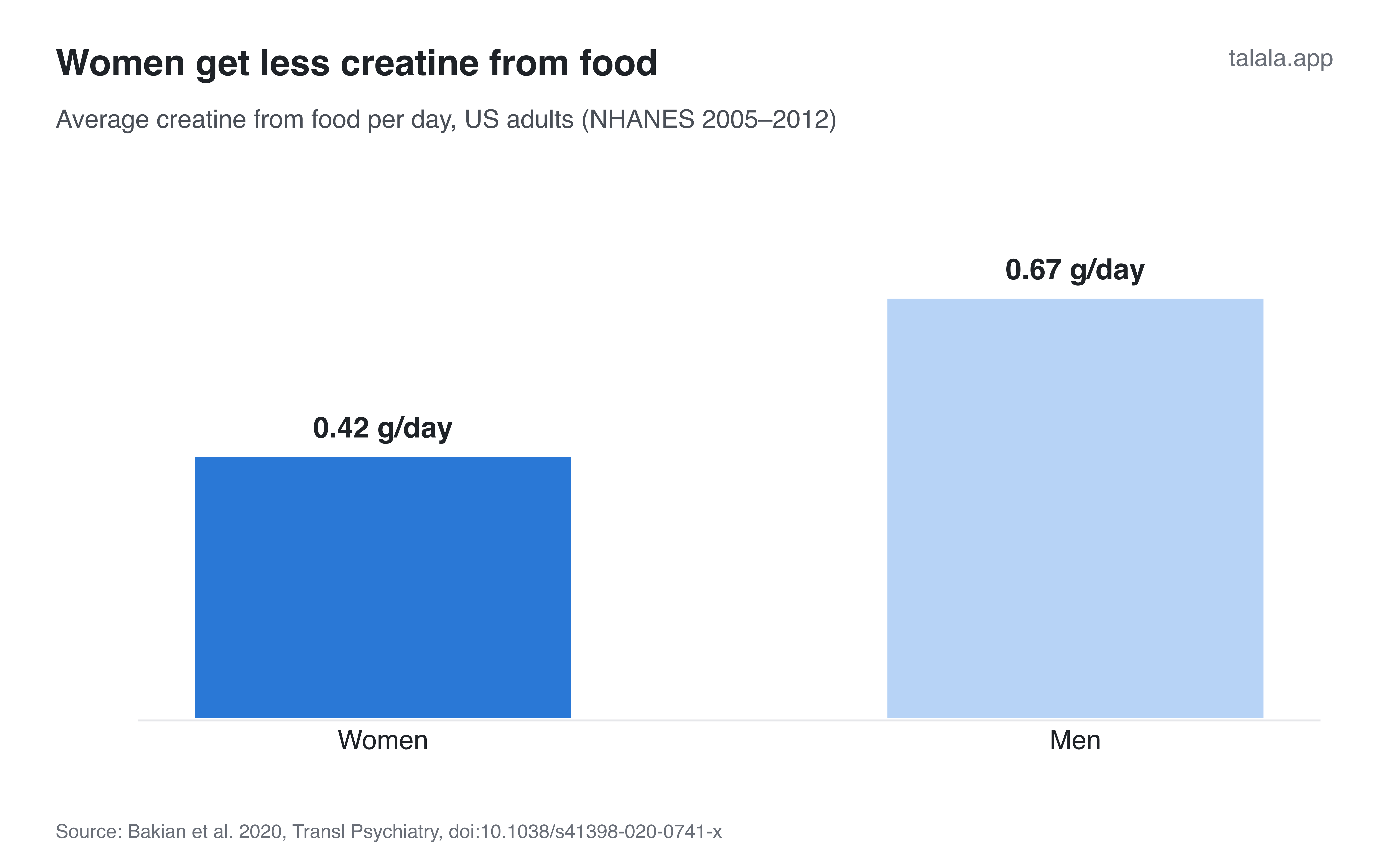
Women get about 0.4 grams of creatine a day from food. Men get closer to 0.7.
That's from a big US nutrition survey of more than 18,000 adults (Bakian et al., 2020 [https://doi.org/10.1038/s41398-020-0741-x]), and it made sense to me the second I saw it. A pound of raw beef or salmon has about 1 to 2 grams of creatine in it (Kreider et al., 2017 [https://doi.org/10.1186/s12970-017-0173-z]), and I eat a lot more Greek yogurt than steak.
What is creatine, and what does it do?
I've taken creatine for a while now, and my friends always ask me the same four things: what is it, how much, when, and is it even worth it for us.
Creatine is something your body already makes, mostly in your liver and kidneys, out of a few amino acids. About 95% of it ends up in your muscles, and about two-thirds of that is stored as phosphocreatine (Kreider et al., 2017 [https://doi.org/10.1186/s12970-017-0173-z]).
The easiest way I've found to think about it is a backup battery. When you do something hard and short, like a heavy set of squats or a sprint up the stairs, your muscles burn through their quick energy in seconds. Phosphocreatine refills it fast so you can keep going a little longer.
On a normal diet your muscles are only about 60 to 80% full of creatine, and taking it can raise that by 20 to 40% (same position stand). That's the whole reason people take it.
How much creatine should women take?
Three to five grams a day. That's what both big sports nutrition reviews say (Kreider et al., 2017 [https://doi.org/10.1186/s12970-017-0173-z]; Antonio et al., 2021 [https://doi.org/10.1186/s12970-021-00412-w]). A review on women specifically says we can follow the same dosing as men (Smith-Ryan et al., 2021 [https://doi.org/10.3390/nu13030877]).
Should women load creatine?
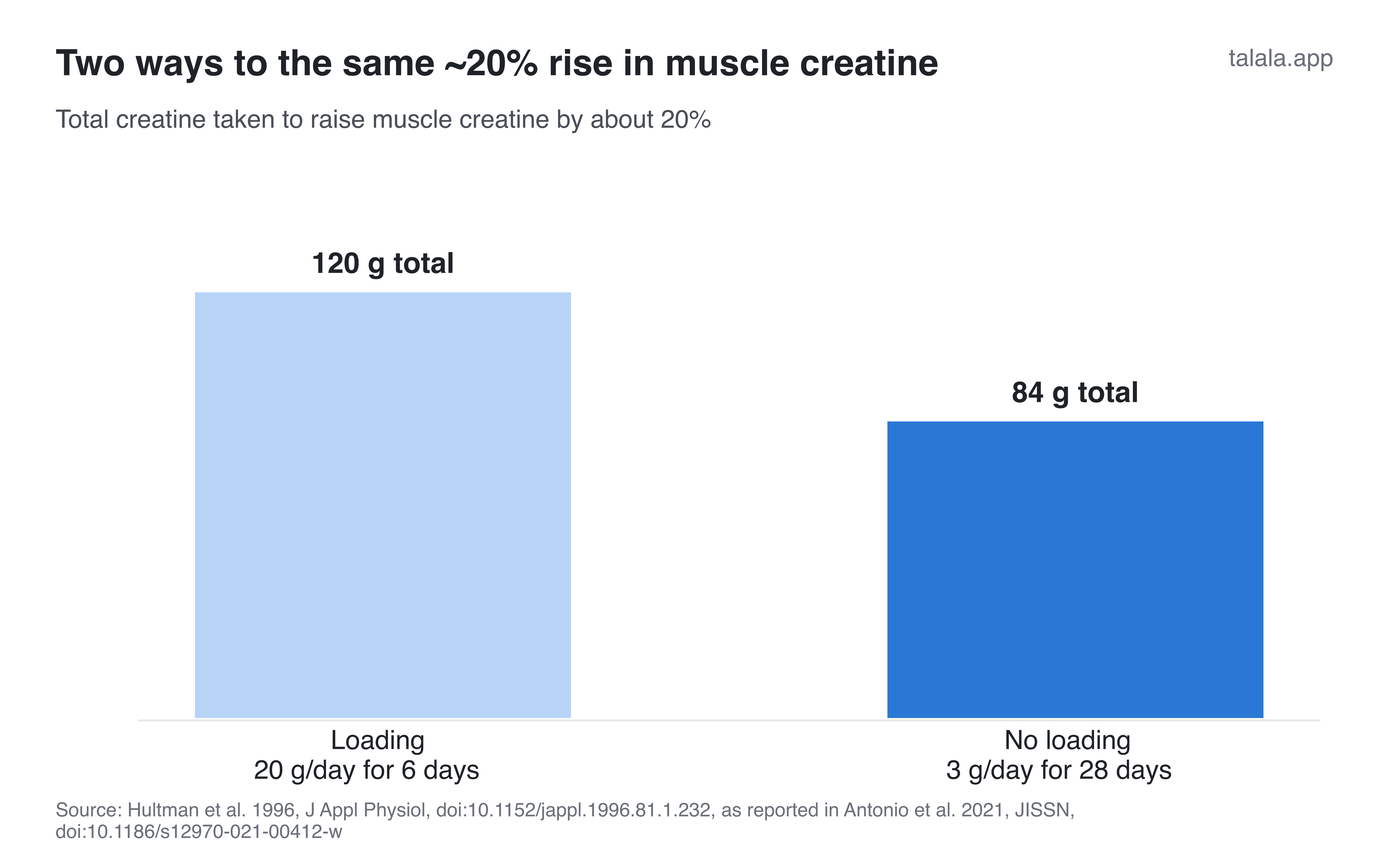
You'll also see "loading," which is about 20 grams a day split into four doses for five to seven days. It fills your muscles faster. I skip it, because 3 grams a day for 28 days got muscle creatine up by about the same amount, around 20%, in the classic study on this (Antonio et al., 2021 [https://doi.org/10.1186/s12970-021-00412-w]). It just takes a month instead of a week.
What are the downsides of loading creatine?
Loading can also add a few pounds of water early on, which is another reason I didn't bother.
When should women take creatine?
Whenever you'll remember it. A 2021 review of the timing research said changing when you take creatine around your workout "is not currently supported by solid evidence" (Ribeiro et al., 2021 [https://doi.org/10.3390/nu13082844]).
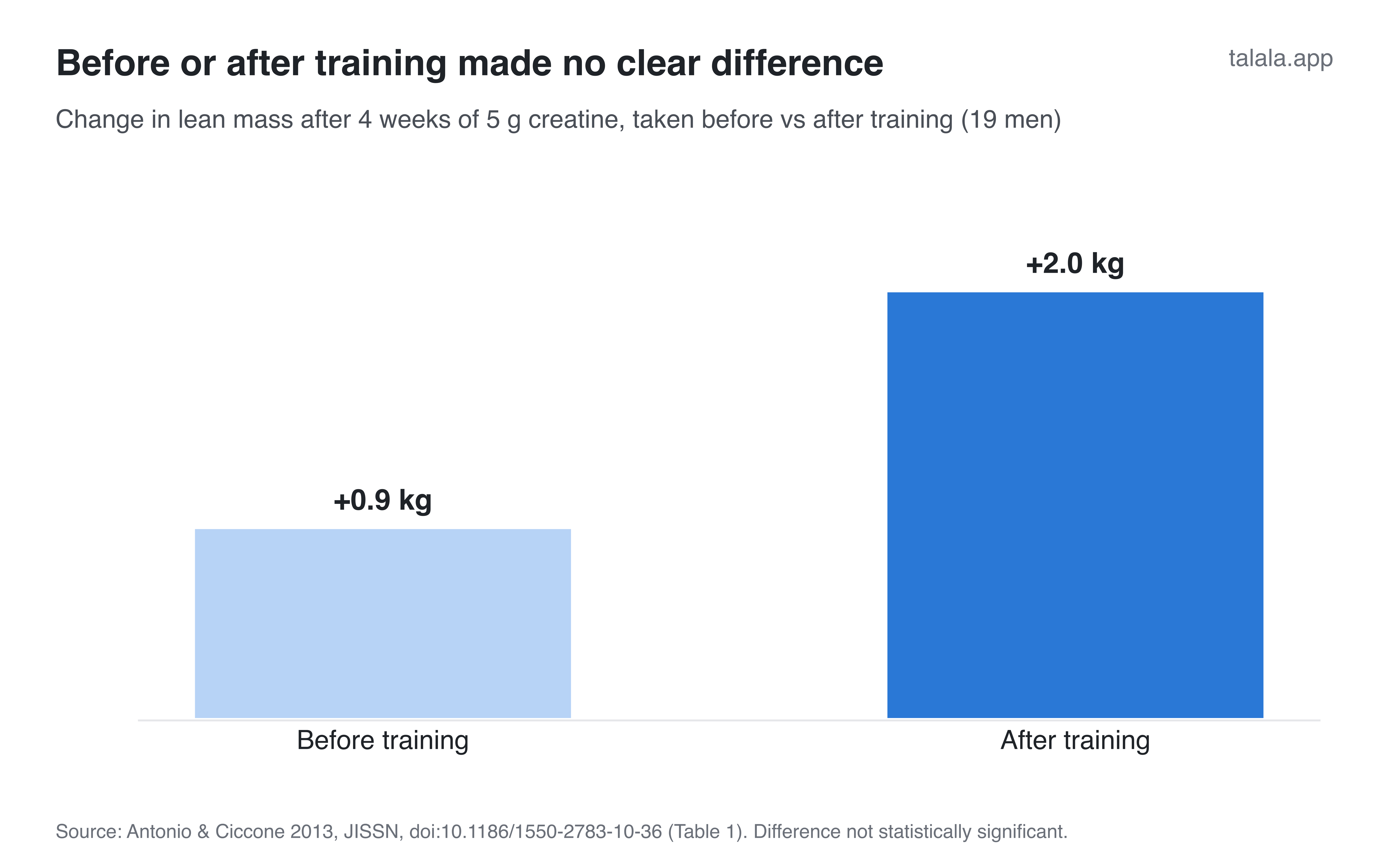
There's one small study people love to quote. Nineteen male bodybuilders took 5 grams either right before or right after training for four weeks, and the after group gained a bit more lean mass, 2.0 kg versus 0.9 kg (Antonio & Ciccone, 2013 [https://doi.org/10.1186/1550-2783-10-36]). The difference wasn't statistically significant and there were no women in it.
Should women take creatine with food?
The one thing I'd do is take it with food. The women's review suggests having it with a meal or in a protein shake (Smith-Ryan et al., 2021 [https://doi.org/10.3390/nu13030877]), and I stir mine into my morning coffee next to breakfast. Hot liquid just helps it dissolve, and creatine breaks down faster the longer it sits in warm liquid, so I drink it right away (Antonio et al., 2021 [https://doi.org/10.1186/s12970-021-00412-w]).
What kind of creatine should women take?
Plain creatine monohydrate. It's the form almost all the research used, and nothing else has been shown to get more creatine into your muscles (Kreider et al., 2017 [https://doi.org/10.1186/s12970-017-0173-z]). I buy the plain unflavored tub.
Does creatine improve strength in women?
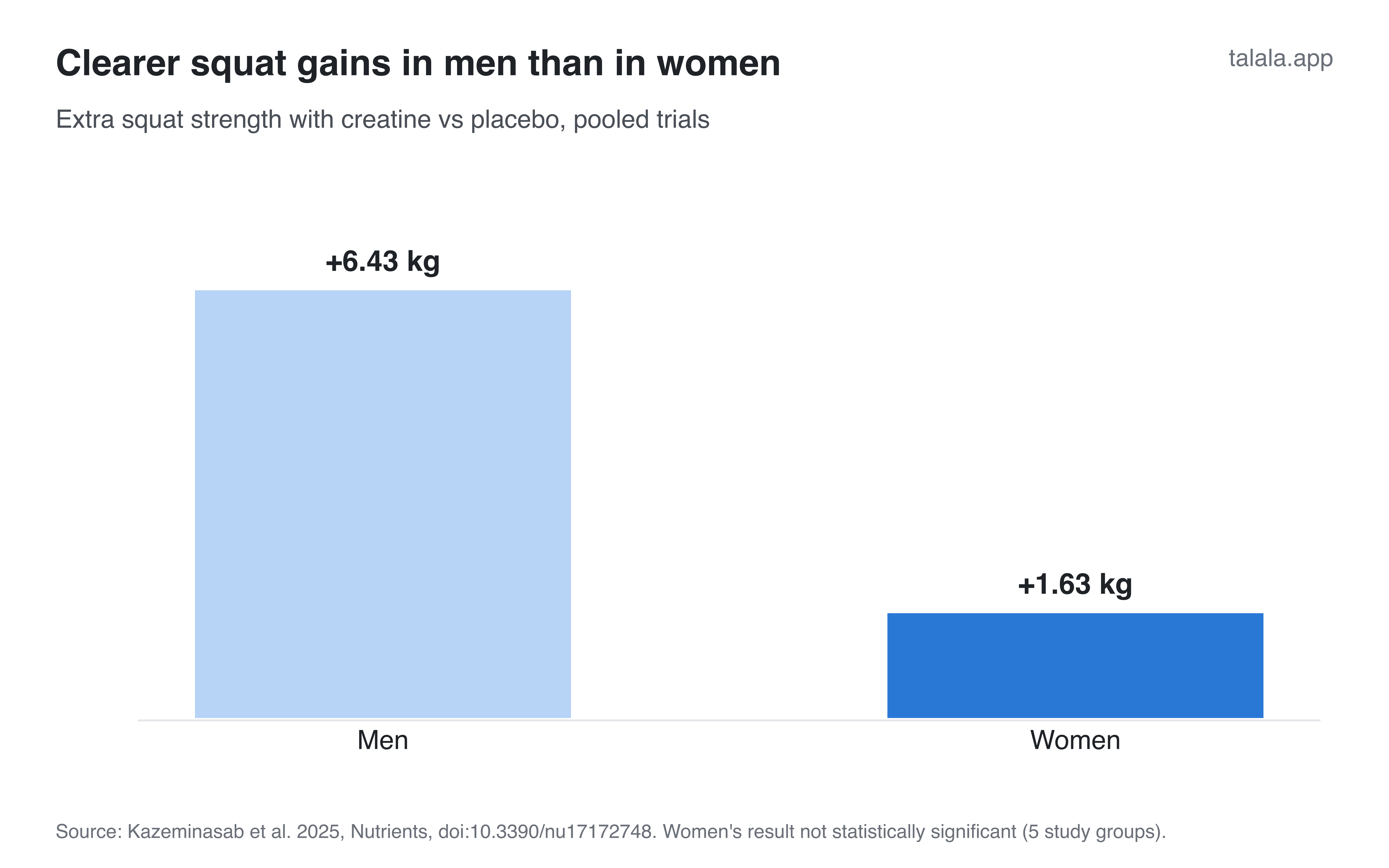
I'll be upfront here, the strength research on women is thinner than on men. A 2025 review of 69 trials found clear strength gains in men on creatine, like about 6.4 kg more on the squat. For women the squat gain was 1.6 kg and not statistically clear, though there were only five groups of women in that analysis (Kazeminasab et al., 2025 [https://doi.org/10.3390/nu17172748]).
Can creatine help preserve hip bone strength after menopause?
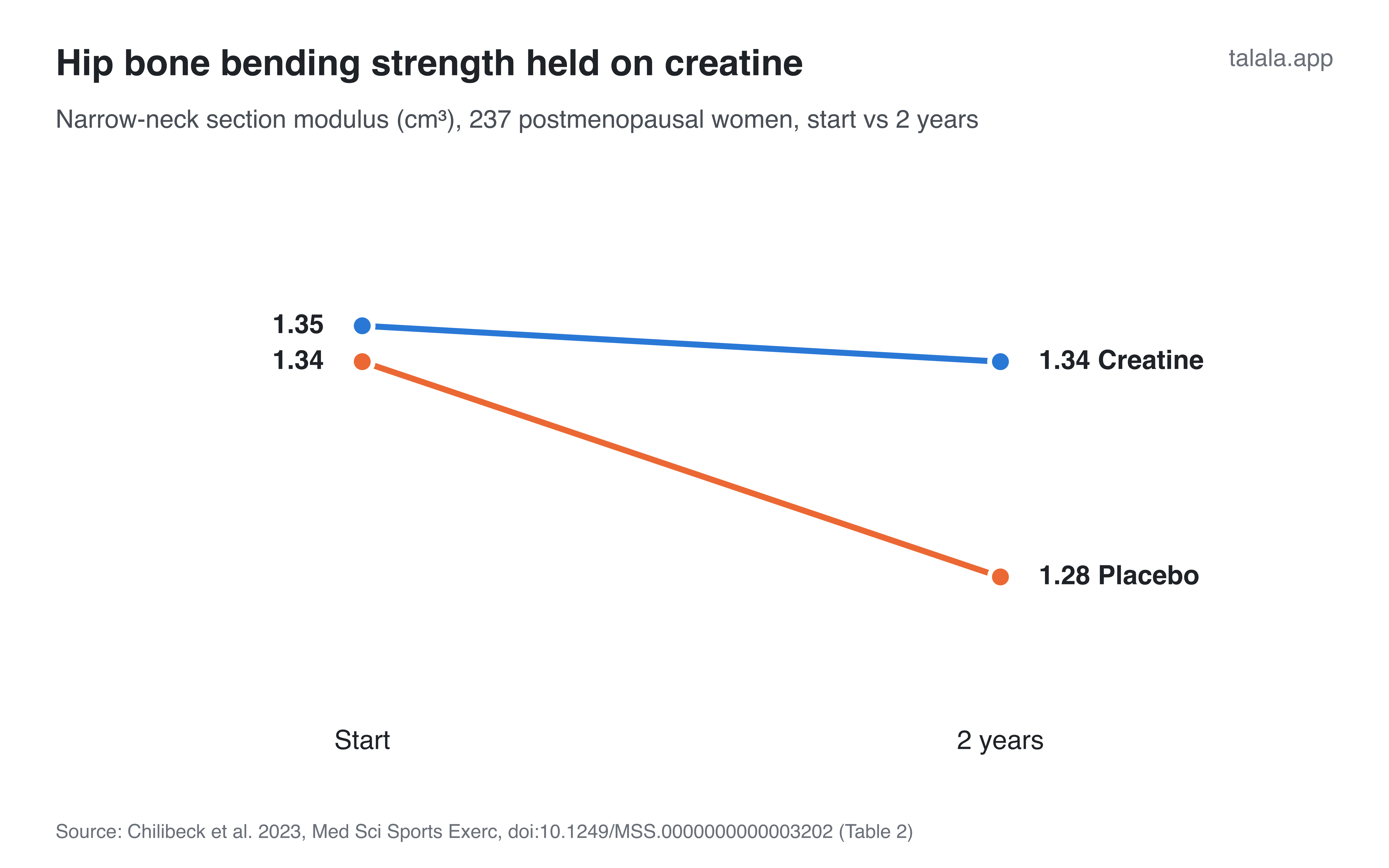
What keeps me taking it is a two-year trial in 237 postmenopausal women who were all strength training (Chilibeck et al., 2023 [https://doi.org/10.1249/MSS.0000000000003202]). One measure of how well the hip bone resists bending dropped on the placebo, from 1.34 to 1.28, and held on creatine, 1.35 to 1.34. They were prescribed about 10 grams a day, though on average they took only about half of it.
How does creatine fit with strength training?
I still think the lifting's doing most of the work for me. I use an AI coach to walk me through each session [https://go.talala.app/m], and every month or so I check where I stand for my age, muscle by muscle [https://go.talala.app/m] to see if anything's moving.
Do women need to cycle creatine or take breaks?
I don't cycle it. If you stop, your muscle levels drift back to normal over about four to six weeks, and there's no evidence it shuts down your body's own production for good (Kreider et al., 2017 [https://doi.org/10.1186/s12970-017-0173-z]).
Note: this isn't medical advice. If you have a kidney condition, are pregnant, or take regular medication, check with your doctor before starting creatine.
Talala is where your plan is only yours
Made by women, made for you, backed by science
- Get a workout plan built around your goals
- AI coach led workout sessions, never feel confused about the gym again
- A Strength Map of every muscle, measured from your own sets
Meet your personal trainer: every workout planned for you, and coached in your ear. Download Talala on the App Store