How many days a week should women strength train?
Two days is the minimum the big health bodies recommend. The WHO guidelines say muscle-strengthening on 2 or more days a week, working all the major muscle groups, and the American College of Sports Medicine's 2026 position stand says the same: at least twice a week, with high effort.
That ACSM review pulled together 137 systematic reviews covering more than 30,000 people, and strength went up more with 2 or more sessions a week. They also couldn't find an upper limit, so 3 or 4 days isn't too much if you enjoy it and your week has room.
"High effort" just means the last couple of reps of each set feel hard. That works with lighter weights too, as long as the set gets tough by the end. We get into that in light weights vs heavy weights for toning.
If you'd rather have the whole week planned for you, here's how Talala does strength training for women.
Is 2 days a week enough, or is 3 better?
Two days is enough to get stronger and build muscle. A third day mostly helps because it gives you more room to fit in more sets.
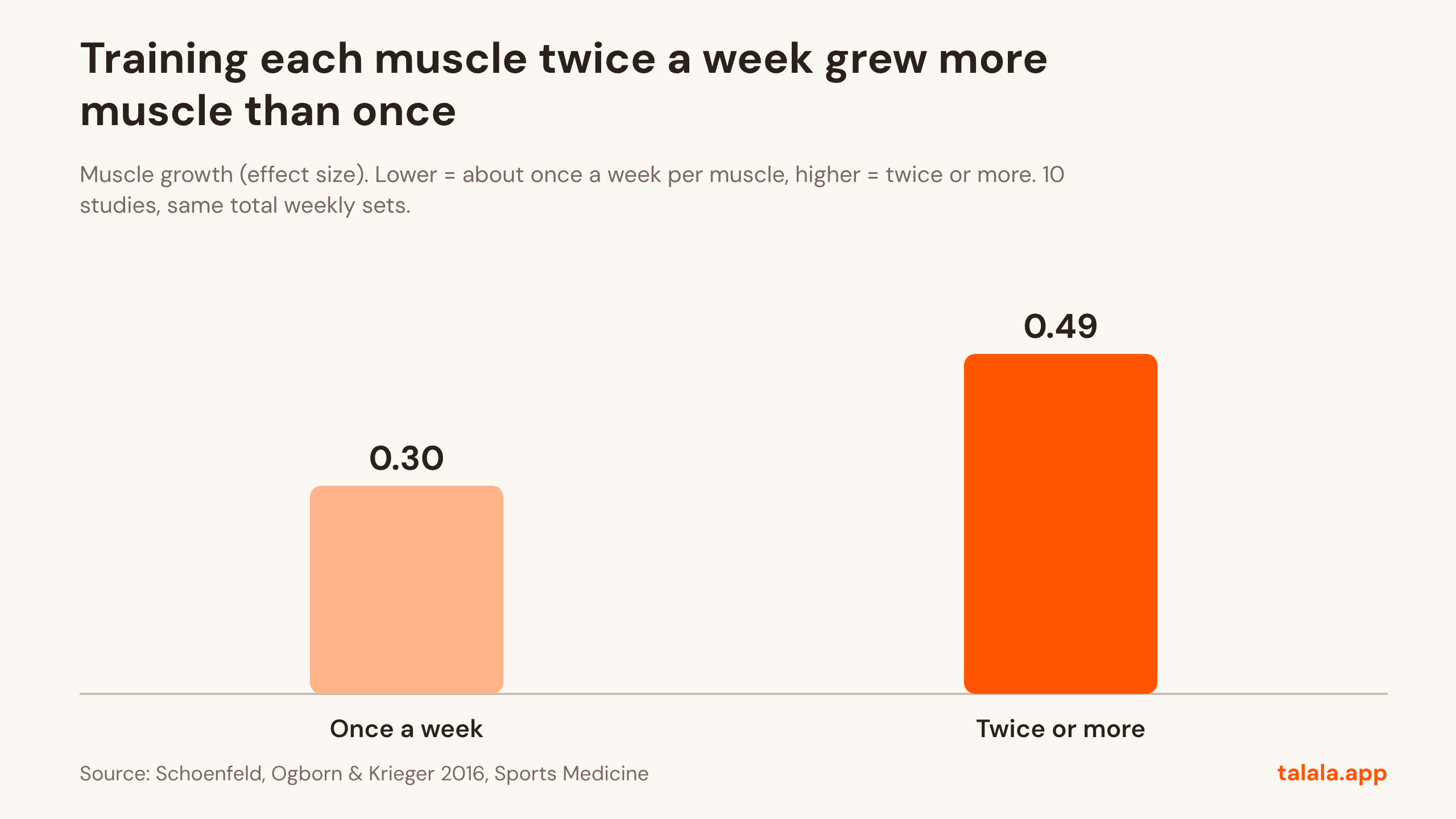
A 2016 meta-analysis of 10 studies found that training a muscle twice a week built more muscle than once a week, even when the total work was the same. Whether 3 times beats 2 is still an open question, and the authors said so.
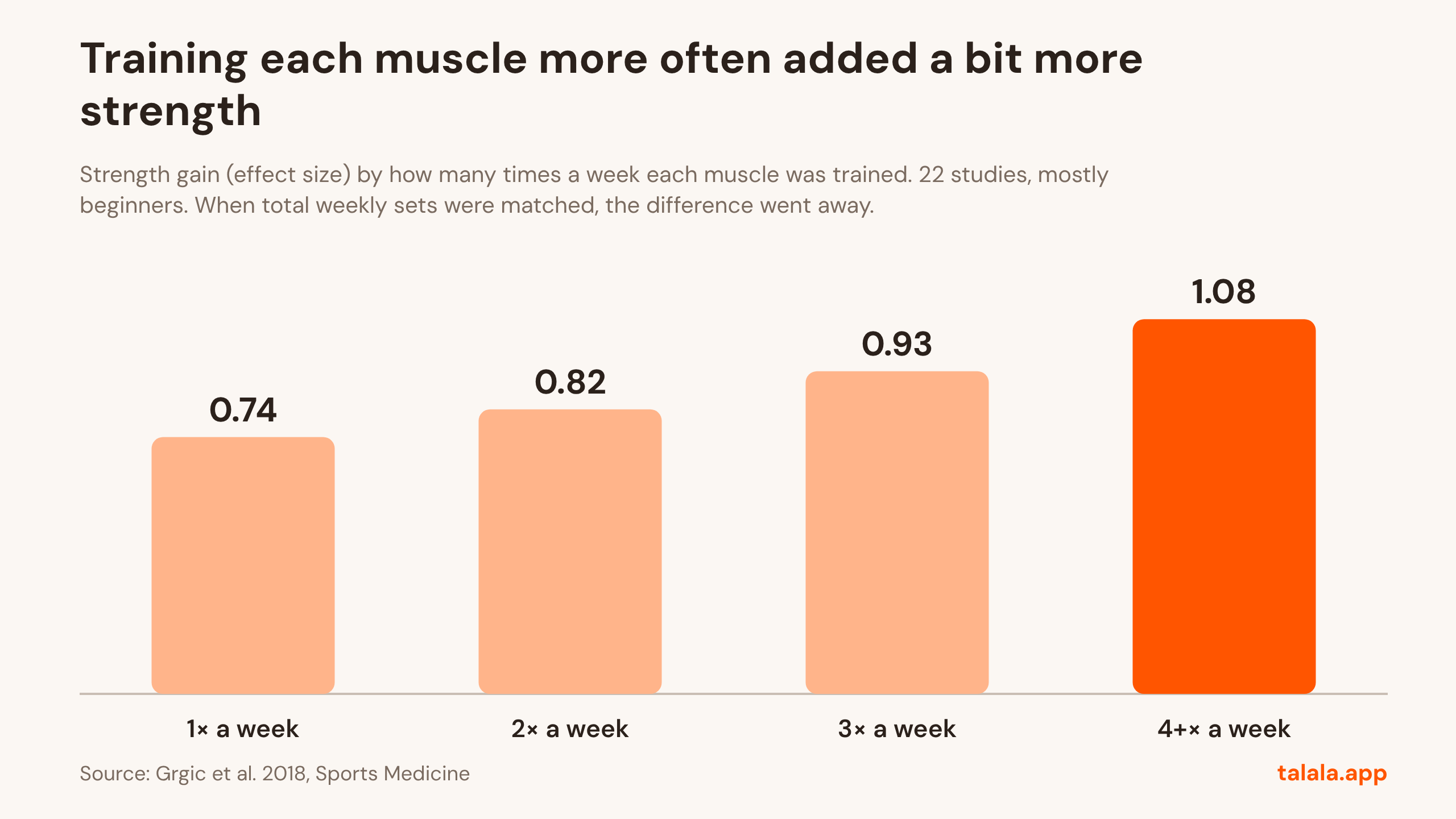
For strength, a 2018 meta-analysis of 22 studies found that training more days a week went with bigger strength gains, and that showed up in women too. But when people did the same number of sets in total, it didn't really matter how many days they spread them over.
So I'd mostly think about how many hard sets each muscle gets in a week, then spread them over whatever days you've got. The ACSM review found muscle growth was better at 10 or more sets per muscle group a week. That's about 5 sets a session on 2 days, or 3 or 4 a session on 3 days.
| 2 days a week | 3 days a week | |
|---|---|---|
| Who I'd pick it for | Busy weeks, brand new, or you're keeping 2+ classes | You've got the time and want shorter sessions or more total work |
| Each session | About 30 to 45 minutes, full body | About 30 minutes, full body |
| Sets per muscle per session | About 5 | About 3 or 4 |
| Rest between sessions | 2 or 3 days | 1 day |
| Example days | Monday and Thursday | Monday, Wednesday, Friday |
How long should each strength training session be?
About 30 to 45 minutes is enough for most women starting out. The ACSM review found strength went up more with 2 to 3 sets, so five or six exercises at 2 or 3 sets each, with rest, fits in that window.
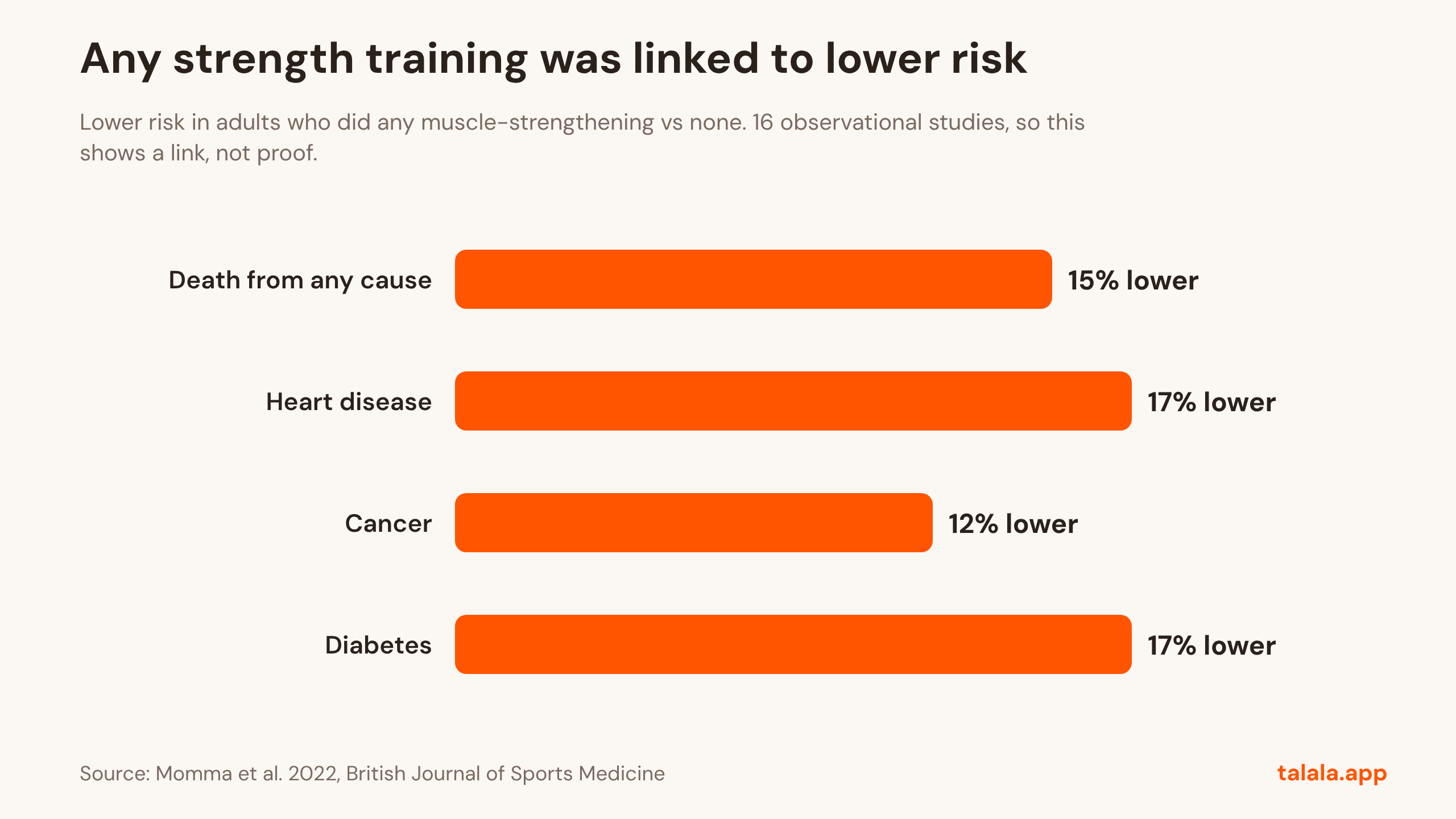
That also matches the 2022 analysis where the biggest drop in risk showed up at 30 to 60 minutes a week. Two half-hour sessions cover it.
If your half hour moves around a lot, Talala, the AI personal trainer app, builds each workout around the time you actually have, anywhere from about 20 to 60 minutes.
Do you need rest days between strength sessions?
If every session is full body, I'd leave at least a day in between, so Monday and Wednesday rather than Monday and Tuesday. Back-to-back days work fine if they hit different muscles, like legs one day and upper body the next.
The ACSM review found that muscle growth was about the same whether people trained 1 day or more than 5 days a week, as long as the total work was the same. So full body vs splitting it up is really about which one fits your week.
Talala keeps track of this for you. Any muscle you trained in the last 48 hours sits out of today's workout, so you won't get legs two days running.
How do you fit strength training around classes or cardio?
If you love your classes, I'd keep them and put strength on days when your legs aren't already fried from class. If you're doing both in one visit, I'd do the strength part first.
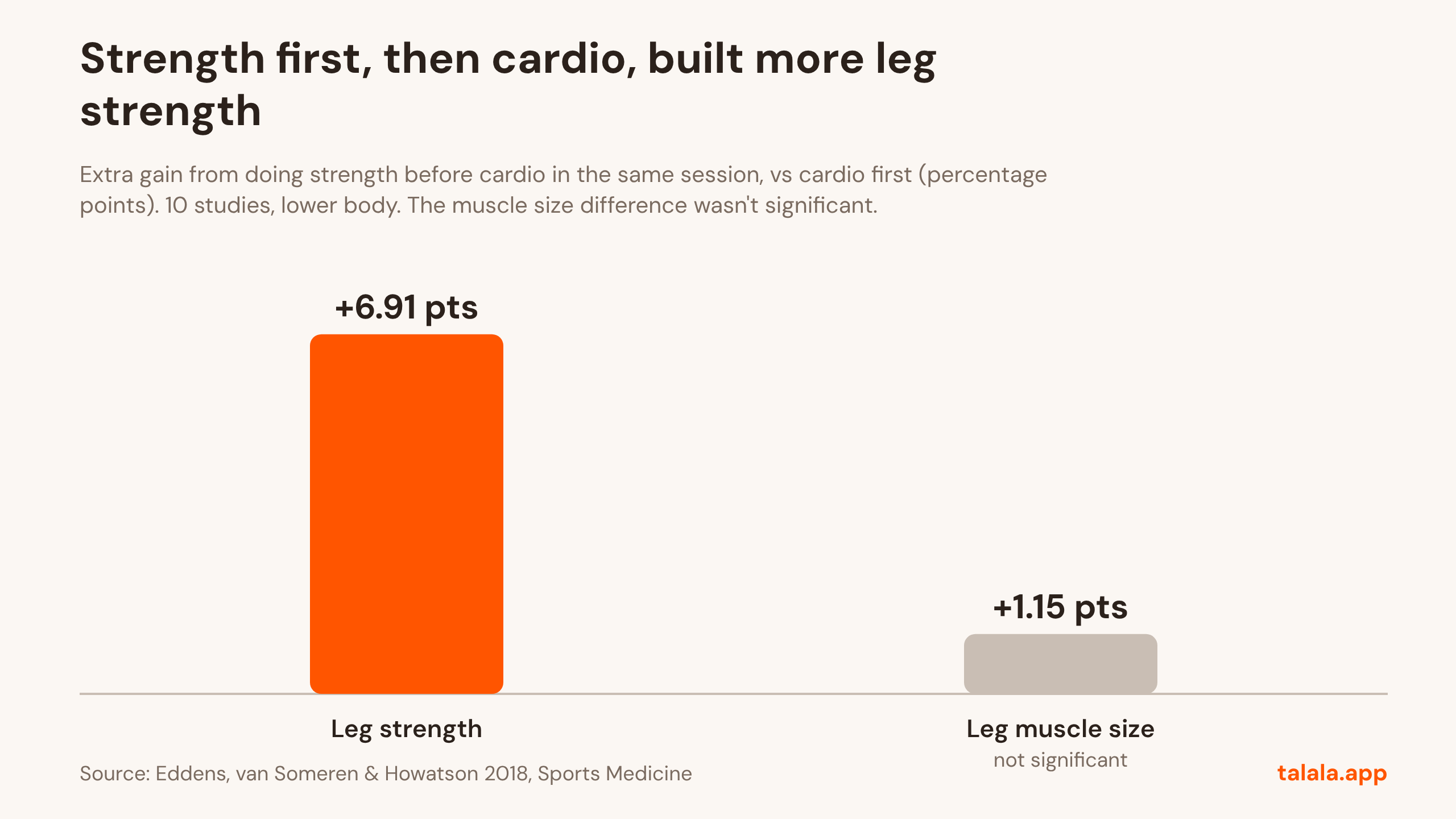
A 2018 meta-analysis found people who did strength first got about 7 percentage points more leg-strength gain than people who did cardio first, with no difference in muscle size, cardio fitness or body fat. The ACSM review also found strength went up more when strength work came at the start of a session. A 5 to 10 minute easy warm-up on the bike first is totally fine.
Here are three weeks I'd use:
| Mon | Tue | Wed | Thu | Fri | Sat | Sun | |
|---|---|---|---|---|---|---|---|
| 2 days, packed week | Strength (30 min) | Rest | Walk | Strength (30 min) | Rest | Walk or run | Rest |
| 2 days + classes | Strength | Barry's | Rest | Strength | Rest | Reformer Pilates | Rest |
| 3 days | Strength | Walk | Strength | Rest | Strength | Class or run | Rest |
Each strength session should cover a squat, a hinge (like a Romanian deadlift or hip thrust), a push, a pull, and some core. If you want the exact moves, sets and weights for your first month, the 4-week beginner gym plan for women has it laid out.
What if you miss a week?
It happens to everyone, especially with little kids. I'd pick up where you left off, maybe a bit lighter on the first day back, and just carry on with your normal week.
If your week blows up halfway through, you can ask your coach to change today's session or the rest of the month. And if you've been training a few months and the numbers have stopped moving, why you've stopped getting stronger covers the most common reasons.
Frequently asked questions
Can women strength train every day?
You can, as long as you're not working the same muscles two days running. The ACSM review couldn't find an upper limit on days per week, but for most women starting out, 2 or 3 full-body days a week is plenty.
Is once a week of strength training worth it?
Yes. In the 2022 analysis, doing any muscle-strengthening at all was linked to about a 15% lower risk of dying from any cause compared with none. Those studies just watched people over time, though, so they can't prove it was the strength training that did it. For building muscle, though, twice a week beat once a week in the 2016 meta-analysis, so I'd add a second day when you can.
Do Pilates or Barry's count as strength training days?
They can count toward the WHO's 2 days if they work all your major muscles hard enough that the last reps feel tough. The thing I'd watch is whether the weight ever goes up. If you're using the same 3-pound dumbbells every class, I'd add at least one session where you can keep moving to heavier ones.
Should I do full-body workouts or split upper and lower days?
On 2 or 3 days a week, I'd do full body, because each muscle gets worked 2 or 3 times that way. Splitting into upper and lower days works well once you're training 4 days, since each muscle still gets hit twice.
How soon will I notice a difference training 2 days a week?
Even the shortest trials in the ACSM review ran 6 weeks, and people training in them still got stronger than people who didn't. Changes in the mirror tend to take longer than that, and how long varies a lot from person to person.
Obviously I'm not your doctor, so if something hurts or you're postpartum, check with a doctor or physio first.
Talala is where your plan is only yours
Made by women, made for you, backed by science
- Get a workout plan built around your goals
- AI coach led workout sessions, never feel confused about the gym again
- A Strength Map of every muscle, measured from your own sets
Meet your personal trainer: every workout planned for you, and coached in your ear. Download Talala on the App Store