What are the most common reasons you stop getting stronger?
Some people have two or three of these going at once.
| What's going on | What it can look like | What I'd try |
|---|---|---|
| Same weights for months | The same dumbbells every week, and the last rep never feels hard | Add a rep a week, then go up the smallest jump |
| Too much variety | New exercises every session, so nothing repeats long enough to go up | Keep 4 main moves for a couple of months |
| Main moves done last | Squats after a run or a class, when you're already tired | Do your main moves first |
| Not tracking | You're not sure what you did last week, so you guess | Write down weight and reps for your main moves |
| Not enough recovery | Same muscles two days in a row, 5 hours of sleep, not much protein | About 48 hours per muscle, protein at every meal |
Have your weights or reps actually gone up?
Your muscles get stronger when you ask them to do slightly more than they're used to, then give them time to recover. People call this progressive overload, which just means you do a little more over time. The American College of Sports Medicine's 2026 position stand, which pulled together 137 systematic reviews covering more than 30,000 people, describes it as increasing the challenge "even if only slightly."
So say your goblet squat is 20 pounds for 3 sets of 8. Next week you go for 9 reps, then 10. Once you can do all 3 sets of 10 with good form, you pick up the 25s and start back at 8. That's the whole technique. If you've been doing 3 sets of 10 with the same dumbbells since spring and the last rep still feels fine, this is probably where your stall is.
The same ACSM review found strength went up more with heavier weights (80% or more of the most you could do for one rep). If you don't know your max (most people don't), it's a weight where the last couple of reps in each set are a real struggle but your form still holds.
That's a lot of numbers to remember. We built Talala, the AI personal trainer app so you walk in already knowing the exact weight, reps and sets for each exercise, and your coach is in your ear every set.
How can you tell if you're still getting stronger?
Pick four main moves and track them every time. I'd go with goblet squat, Romanian deadlift, dumbbell bench press and lat pulldown. Write down the weight and reps for every set. When things are working, you'll usually see the weight or the reps creep up on at least a couple of them over a month or two.
I'd judge it by the trend over a month, since everyone has the odd day where everything feels light.
Talala keeps every set you've ever logged and turns them into a Strength Map, an estimate of how strong each muscle is, so you can see which muscles haven't moved in a while.
Could switching exercises too often be slowing you down?
This one surprises a lot of people coming from classes, where a new workout every time is half the fun. A 2022 systematic review found that some planned variety can help, but swapping exercises too often or at random might slow down how fast you get stronger and build muscle. All eight studies were in young men. Still, if your main moves change every week, nothing repeats long enough for you to add weight to it, so I'd keep the same four main moves for a couple of months and change the smaller exercises around them if you get bored.
Does it matter when and how often you train each muscle?
Workout order is the easiest thing to change. The ACSM review found strength went up more when strength work came at the start of a session. So if you've been doing squats after a 20-minute run, I'd flip it and see what happens over a month.
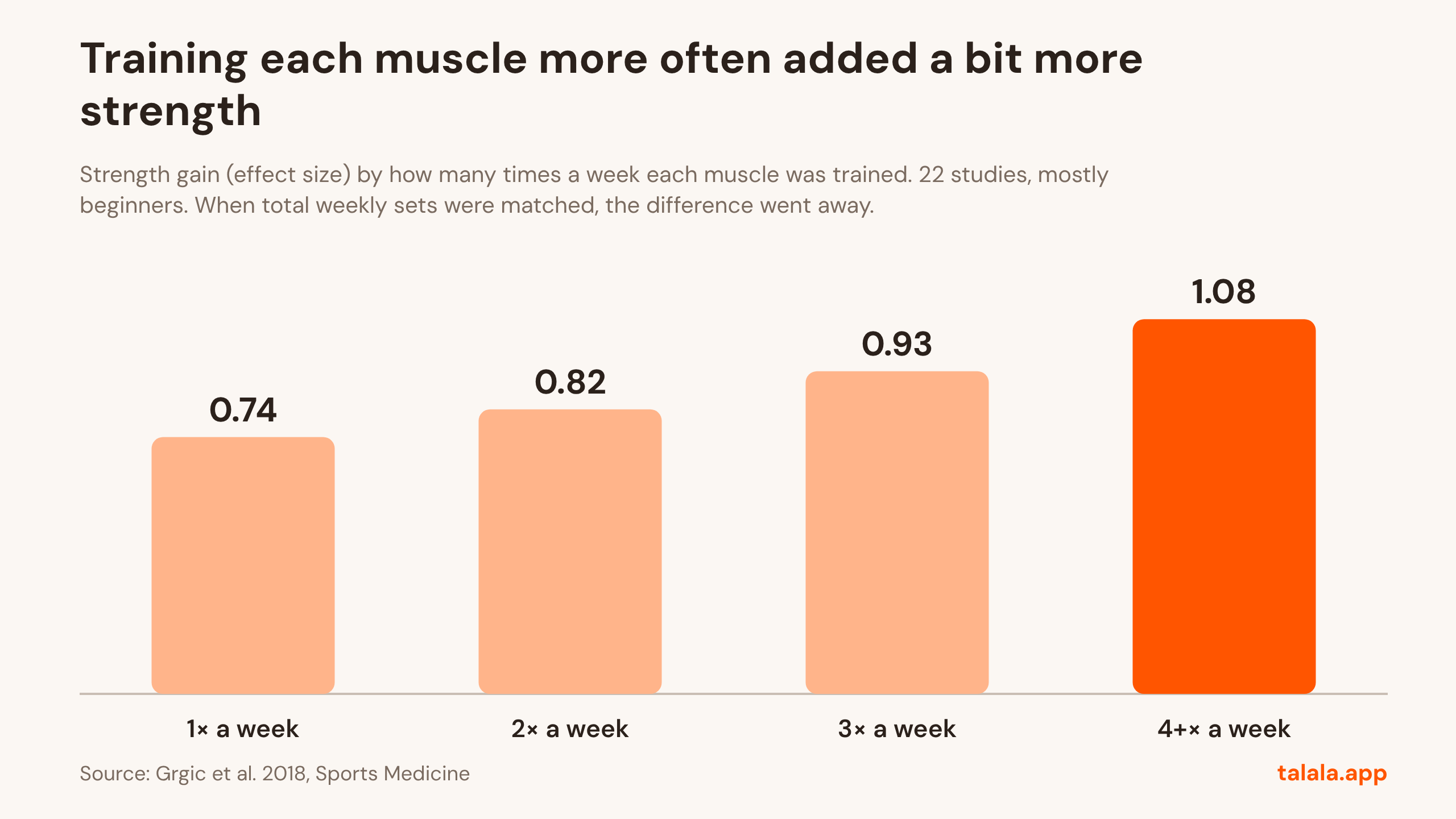
For how often, the ACSM and the WHO guidelines both say to do strength work at least two days a week, hitting all your major muscle groups. A 2018 meta-analysis of 22 studies found strength gains got bigger as people trained more days a week. But when the researchers compared groups doing the same total number of sets, it didn't really matter how many days they split them over.
So if you're down to once a week since work got busy, getting back to two might be the whole fix.
Could sleep, food or rest be holding you back?
Yes, and you don't need to be perfect about any of them.
Rest days. A muscle that's still sore from Tuesday won't have much to give on Wednesday. Talala sits out any muscle you trained in the last 48 hours, so each session works the muscles that have had time to recover.
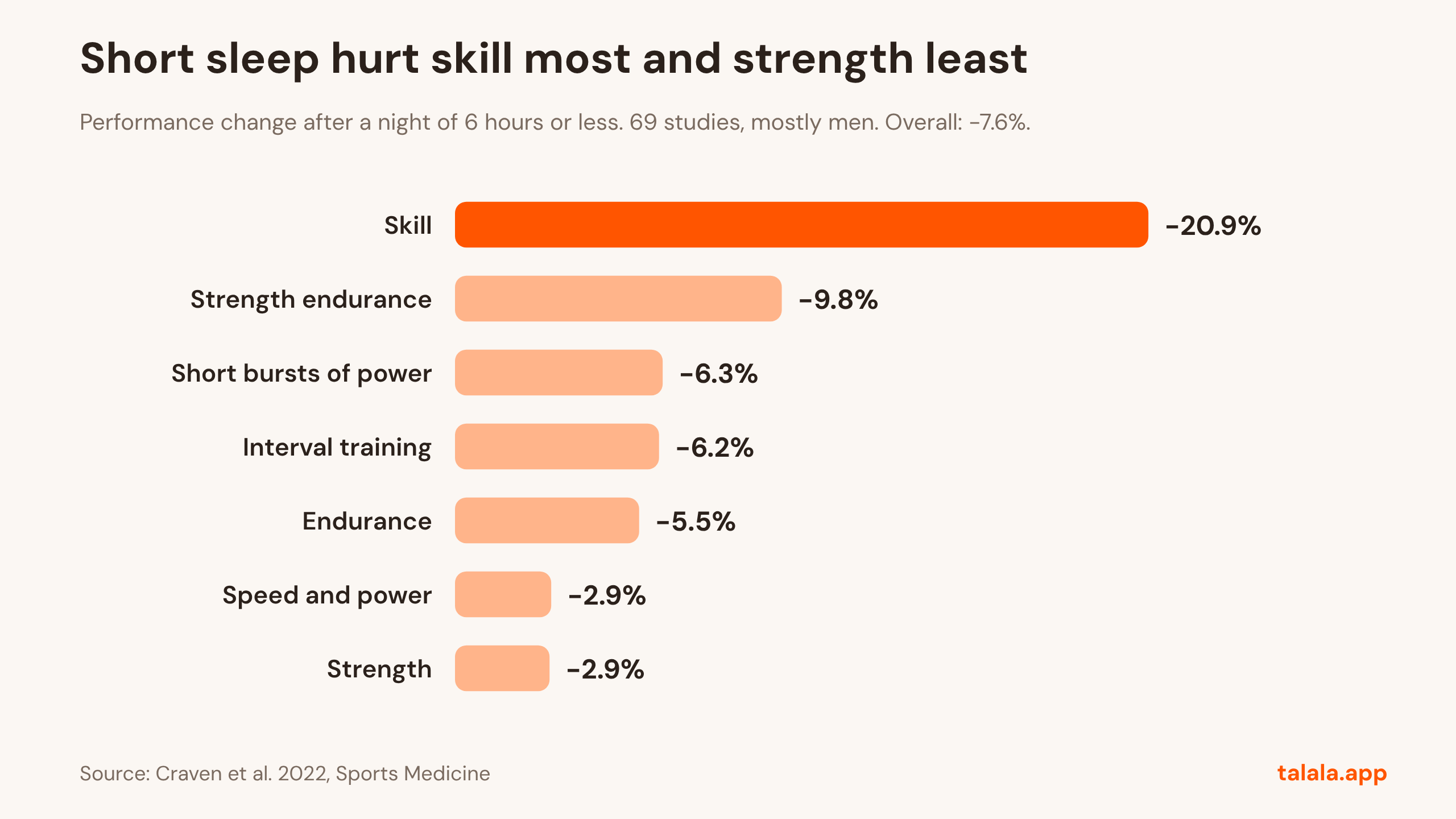
Sleep. The American Academy of Sleep Medicine and Sleep Research Society recommend adults get 7 or more hours a night. A 2022 meta-analysis found that a short night (6 hours or less) cut next-day exercise performance by about 7.6% on average, and strength tasks were affected too. Most people in those studies were men, and they only looked at the very next workout. Still, if you've been running on 5 or 6 hours lately, a flat month at the gym might have more to do with that than with your plan.
Protein. The International Society of Sports Nutrition says 1.4 to 2.0 grams of protein per kilogram of body weight a day is enough for most people who exercise. A meta-analysis of 49 studies found that going past about 1.6 g/kg a day didn't add much more muscle. For a 150-pound woman (about 68 kg), 1.6 g/kg is roughly 110 grams a day, spread over three or four meals. If you're eating less to lose fat at the same time, we go deeper in how to keep muscle in a calorie deficit.
What should you change first?
I'd pick the one or two reasons that sound most like you and change only those for four weeks. If you're not sure, this reset covers most of them at once:
- Do goblet squats, Romanian deadlifts, bench press and lat pulldowns first, two or three times a week, with a day off in between.
- Add a rep each week. When you hit the top of the range on every set, go up the smallest jump and start back at the bottom.
- Write down the weight and reps every time.
- Do whatever extras you like after them, and swap those around as much as you want.
| Main move | Sets x reps | Rest | Home swap |
|---|---|---|---|
| Goblet squat | 3 x 8–10 | 2 min | Same, holding one dumbbell or a loaded backpack |
| Dumbbell Romanian deadlift | 3 x 8–10 | 2 min | Same, with dumbbells or a loaded backpack |
| Dumbbell bench press | 3 x 8–10 | 2 min | Push-ups, hands on a counter or couch if needed |
| Lat pulldown | 3 x 10–12 | 90 sec | Band pulldown from a door anchor |
If the cable machine's taken or your knee's cranky that day, you can ask your coach mid-set for a backup move instead of skipping it. And if you'd rather have the whole thing planned for you, here's how Talala does it.
Frequently asked questions
Is it normal to stop getting stronger after a year?
Yes, really normal. The first few months move fast, then the steps get smaller and further apart. If nothing has moved for a couple of months, it's usually something small, like the weights not going up or squats coming after a run.
How long should a plateau last before I change something?
If your main moves haven't budged in two or three months of tracking, I'd pick the reason that sounds most like you and try that fix for a month.
Do I need to train to failure to get past a plateau?
No. The ACSM review found people got about as strong whether they pushed every set to failure or not. Ending most sets with a rep or two left in you is fine.
Should I go heavier or do more reps when I'm stuck?
Both build muscle, and heavier works better for strength. A 2017 meta-analysis found people built about the same muscle with light or heavy weights when they took every set to failure, but the people using heavy weights got stronger. If getting stronger is your main goal, I'd keep your main moves in the 6 to 10 rep range.
Can I keep getting stronger training at home?
Yes. The ACSM review found people got stronger training at home and with bands. You can run out of weight to add at home, though, so if you've stalled at home, I'd look at heavier dumbbells, slower reps or harder versions of each move.
Obviously I'm not your doctor, so if something hurts or you're postpartum, check with a doctor or physio first.
Talala is where your plan is only yours
Made by women, made for you, backed by science
- Get a workout plan built around your goals
- AI coach led workout sessions, never feel confused about the gym again
- A Strength Map of every muscle, measured from your own sets
Meet your personal trainer: every workout planned for you, and coached in your ear. Download Talala on the App Store