What does each week of the plan look like?
Two or three days a week, and every session works your whole body. That's what the American College of Sports Medicine's position stand on resistance training recommends for people who are new: train the entire body 2–3 days a week, starting with one to three sets per exercise. The WHO guidelines say the same for all adults: muscle-strengthening work for every major muscle group on 2 or more days a week.
Here's how I'd set up the days:
- Monday: Workout A
- Wednesday: Workout B
- Friday: Workout A (optional third day, from week 2)
- The next week: flip it, so B, A, B
And here's how the four weeks build:
| Week | Days | Sets x reps | What you're going for |
|---|---|---|---|
| 1 | 2 (A, B) | 2 x 10 | Learn the moves and find your starting weights. Write every weight down |
| 2 | 2–3 | 3 x 10 | Same weights, all three sets with clean form |
| 3 | 2–3 | 3 x 12 | Same weights, two more reps per set |
| 4 | 2–3 | 3 x 10 | Go up one step on anything where you got all 12 reps two sessions in a row |
If you love your Barry's or Pilates class, I'd keep one on a Tuesday or Thursday, and if your legs are sore, Pilates is a nicer pairing that day than a sprint-heavy class. Leaving a day between the weights sessions gives the same muscles time to recover. If juggling all of that sounds like a lot, Talala, the AI personal trainer app, plans your week around your schedule and keeps any muscle you trained in the last 48 hours out of today's session.
What are the two workouts?
Each one takes about 40 minutes. For the warm-up I'd do five minutes on the bike or an incline walk, then one light set of the first exercise. The ACSM suggests longer rests for the big, heavier exercises, so the leg and glute work gets the full two minutes below.
Workout A
| Exercise | Sets x reps | Rest | Machine or dumbbell swap | Home swap |
|---|---|---|---|---|
| Leg press | 3 x 10 | 2 min | Dumbbell goblet squat | Bodyweight squat to a chair |
| Lat pulldown | 3 x 10 | 90 sec | One-arm dumbbell row on a bench | Band pulldown (band anchored over a door) |
| Dumbbell Romanian deadlift (RDL) | 3 x 10 | 2 min | Seated leg curl machine | RDL holding a backpack |
| Machine chest press | 3 x 10 | 90 sec | Dumbbell bench press | Incline push-up on a kitchen counter |
| Dead bug | 2 x 8 per side | 45 sec | Pallof press at the cable machine | Dead bug on a mat |
Workout B
| Exercise | Sets x reps | Rest | Machine or dumbbell swap | Home swap |
|---|---|---|---|---|
| Hip thrust machine | 3 x 10 | 2 min | Dumbbell hip thrust, shoulders on a bench | Glute bridge on the floor |
| Seated cable row | 3 x 10 | 90 sec | Chest-supported dumbbell row on an incline bench | Band row |
| Dumbbell goblet squat | 3 x 10 | 2 min | Leg press | Backpack squat |
| Seated dumbbell shoulder press | 3 x 10 | 90 sec | Machine shoulder press | Band shoulder press |
| Side plank (knees down is fine) | 2 x 20 sec per side | 45 sec | Pallof press at the cable machine | Side plank on a mat |
These are the week 2 and week 4 numbers. For weeks 1 and 3, use the sets and reps from the week-by-week table.
Every set should end with the last couple of reps feeling slow and hard, while your form still looks like it did on rep one. If you'd rather have someone tell you the exact number, Talala gives you the weight, sets and reps for every exercise, and your coach talks you through each set in your ear.
How do you pick your starting weights in week one?
I'd think of week one as a test. When the plan says 10 reps, you're looking for a weight you could do about 12 or 13 times. The last two reps should slow down but still look clean.
- If 10 felt easy and you could've kept going to 15, go up one step on the next set.
- If your form changed before rep 8 (back rounding, swinging, hips shifting), go down a step.
- On machines, set the pin low, do five easy reps, and move it from there.
If you've been grabbing the 5s or 8s at Barry's for arm work, that's a totally fine place to start for shoulder presses and rows. Legs and glutes are a lot stronger than arms, so the leg press and hip thrust usually need way more weight than you'd guess.
If you're wondering whether the light dumbbells even do anything, we went through the research in light weights vs heavy weights for toning.
How do you know when to go heavier?
The ACSM says once you can do one or two reps more than your target, two sessions in a row, you add about 2–10% to the weight.
In this plan that mostly happens in week four. If you got all 12 reps on every set in week three, here's what I'd go up by:
- Dumbbells: the next pair up, usually 2.5 or 5 lb heavier
- Machines: one pin down the stack
- Shoulders and arms: the smallest jump you can find
- Legs and glutes: these can usually handle a bigger jump
Your reps will drop back to 8 or 9 when you go up, and that's normal. You build back up to 12 and then go up again. A weight is too heavy if your back rounds, you swing to get it up, or the reps get shorter.
What if you miss a session or the machine's taken?
If you miss a day, I'd just do the next workout on the list and carry on. If a whole week goes sideways, I'd repeat that week instead of jumping ahead.
Someone's going to be on the machine you want at some point, especially after work. Here's what I'd try, in this order:
1. Asking how many sets they've got left. It's a normal question, and most people will say one or two.
2. Asking to work in, so you take turns while they rest.
3. Doing the next exercise first. The order isn't magic, though the big leg moves are nicer when you're fresh.
4. Using the swap column in the tables.
Talala has 500+ exercises with modifications customized to you, every move has a backup for when the machine is taken, and you can ask your coach mid-set to swap it. If you've told your coach about a sore knee or another sensitive area, it can leave that area out or keep an easier version with a note on how to modify it, and you can ask how to modify a move right there in the session.
What should you expect by the end of week four?
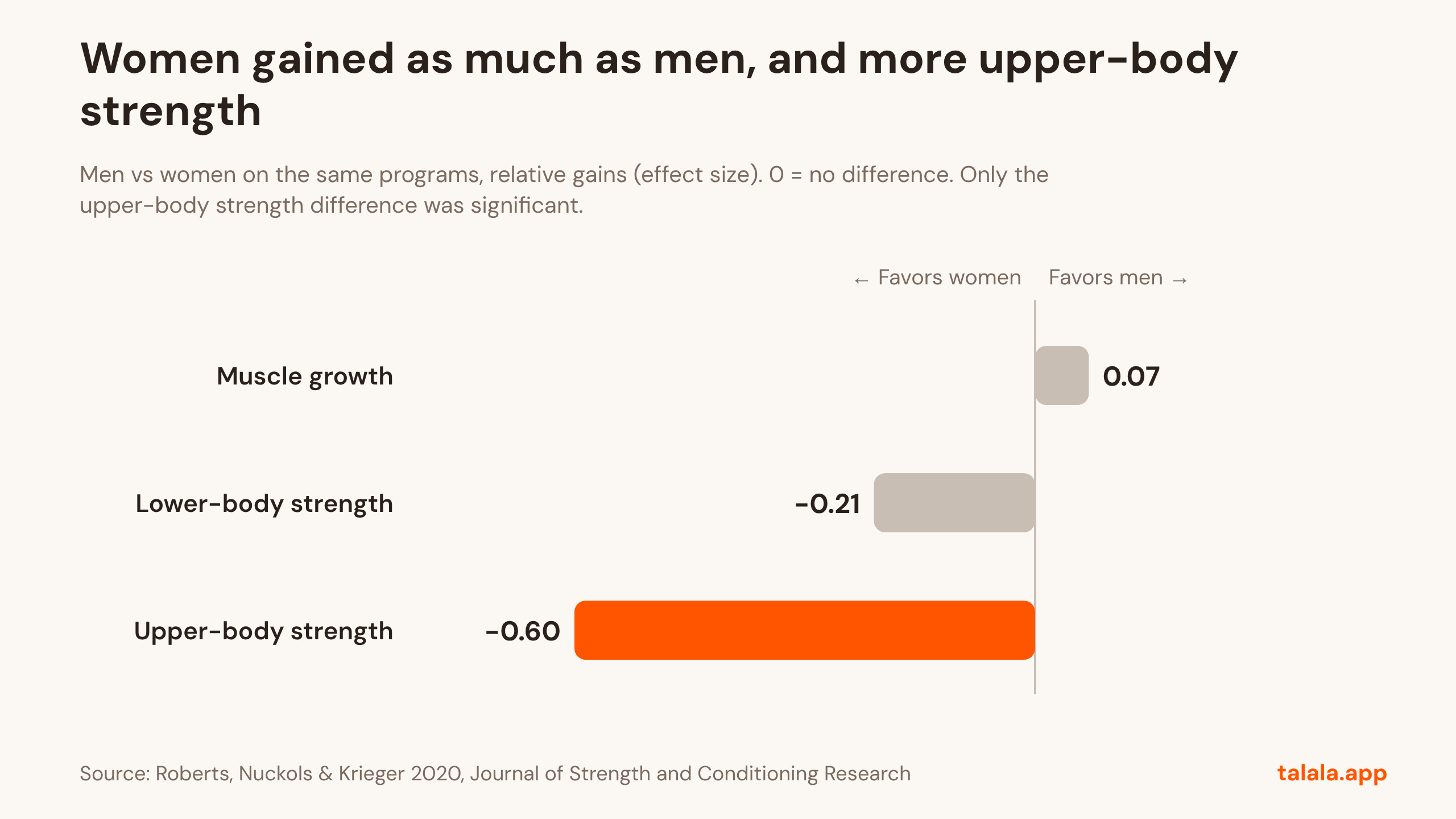
I'd expect three things: you'll probably know all ten moves without checking your phone, you'll have a page of starting weights written down, and a few of those weights will have gone up. Women get stronger from the same program just as well as men do, and sometimes more. A 2020 review pooled studies where men and women did the exact same program. Women built muscle at a similar rate relative to where they started, and gained more upper-body strength relative to their starting point than the men did.
The mirror usually takes longer than a month to show much, so this early I'd just check whether the numbers in your notes went up.
What do you do after the 4 weeks?
I'd run the same two workouts for another month and keep going up a step whenever you hit 12 reps. Swapping one or two exercises is fine if you're bored, but keeping most of them the same is how you see the weights climb. If things slow down a few months in, why you've stopped getting stronger covers what to change.
If you'd rather have week five onward planned for you, here's how Talala does it.
FAQ
Can I do this plan only 2 days a week?
Yes. Two full-body days a week fits both the ACSM and WHO guidance, and week one is built for two days anyway. If you want the longer answer on frequency, it's in how often should women strength train.
How long does each workout take?
About 40 minutes with a warm-up. On a busy day you can drop the core move and the third set of everything and still get a useful 25 minutes in.
Can I do this 4-week plan at home?
Yes. Every exercise has a home swap in the last column, and a pair of dumbbells and a resistance band cover most of it.
Should I do cardio before or after the workout?
I'd do weights first while you're fresh, then cardio after if you want it. If your goal is to lose fat while keeping muscle, I'd still keep the weights first on cardio days, and how to keep muscle in a calorie deficit goes into fitting both in.
Will this plan make me bulky?
No. Building muscle is slow for everyone, and two or three full-body sessions a week with moderate weights mostly just make you stronger. The really muscular women you see usually trained for years on purpose, with way more sets and food than this.
Obviously I'm not your doctor, so if something hurts or you're postpartum, I'd check with a doctor or physio first.
Talala is where your plan is only yours
Made by women, made for you, backed by science
- Get a workout plan built around your goals
- AI coach led workout sessions, never feel confused about the gym again
- A Strength Map of every muscle, measured from your own sets
Meet your personal trainer: every workout planned for you, and coached in your ear. Download Talala on the App Store