Do light or heavy weights tone better?
"Toned" is mostly muscle you can see, so it comes down to which one builds muscle better. And in the studies so far, they come out pretty even.
In 2026 the American College of Sports Medicine pulled together 137 reviews covering more than 30,000 people for its position stand on strength training. Muscle grew about the same across a wide range of weights, from around 30% of the most you can do once all the way up to your max. What mattered more was effort and doing enough sets, and stopping with about 2 or 3 reps left in the tank was enough.
A meta-analysis of 21 studies where every set went to failure found lighter weights (60% of max or less) and heavier ones grew muscle about equally, and the heavier ones built more strength.
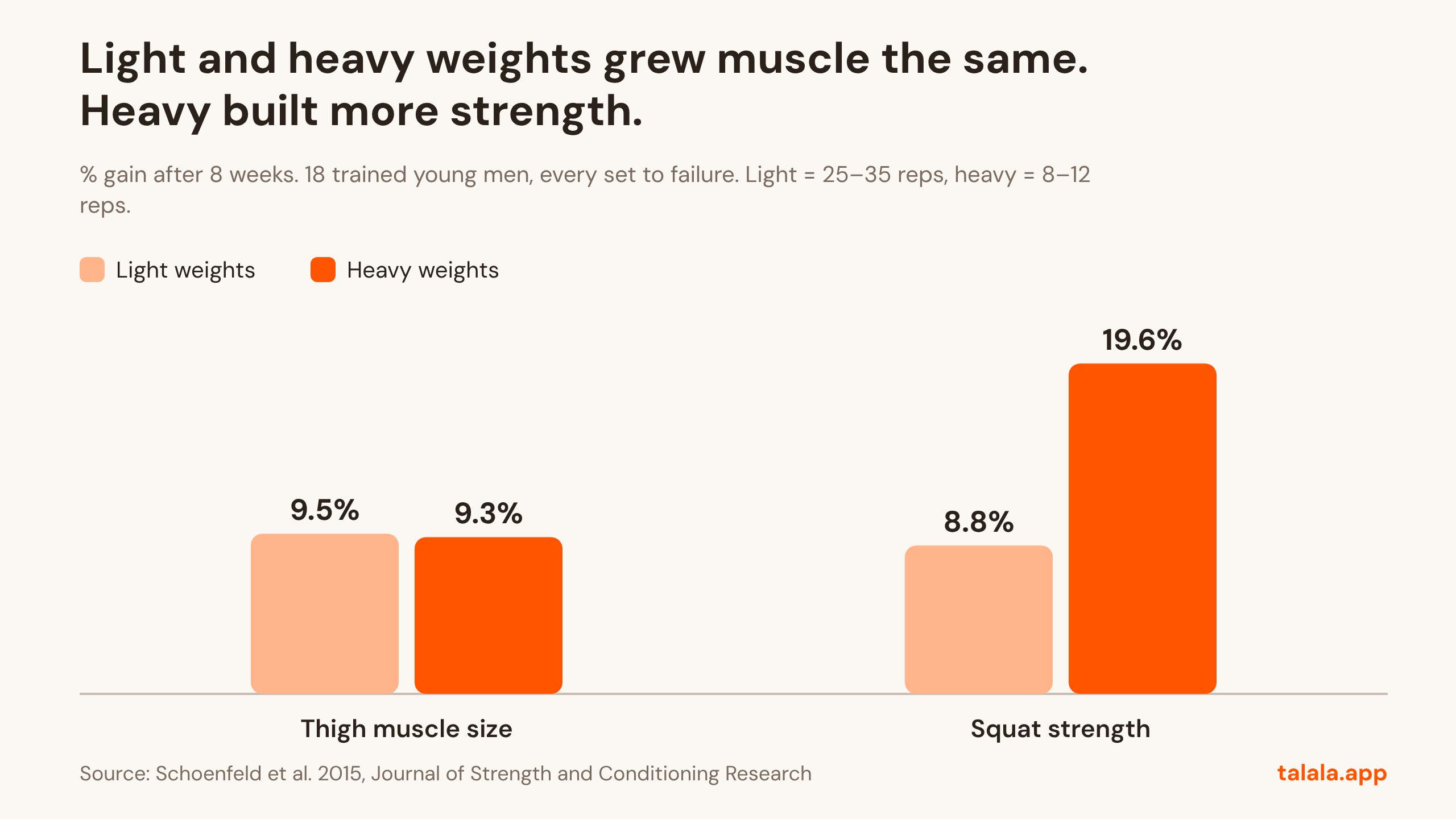
A 2015 study of 18 men who already trained showed the same thing. For 8 weeks, half did 25–35 reps a set and half did 8–12, three times a week, every set to failure. Their thigh muscles grew about the same (9.5% with the light weights, 9.3% with the heavy ones). The heavier group's squat went up 19.6%, though, and the lighter group's went up 8.8%.
If a toned look is the goal, I'd compare the usual options like this:
| What you're doing | Muscle (the "toned" part) | Strength |
|---|---|---|
| Light dumbbells for lots of fast reps that never get hard | Probably not much new, since the sets don't get near that muscle's limit | Not much change |
| Light weights or bands, taken until the last 2–3 reps are a struggle | About the same as heavy | Goes up, but less than with heavy |
| Weights that feel hard by rep 8–12 | About the same as light weights taken close to failure | Goes up the most (ACSM) |
| Very light (around 20% of max), even taken to failure | About half the growth in one study | Went up less than at heavier weights in that study |
How light is too light?
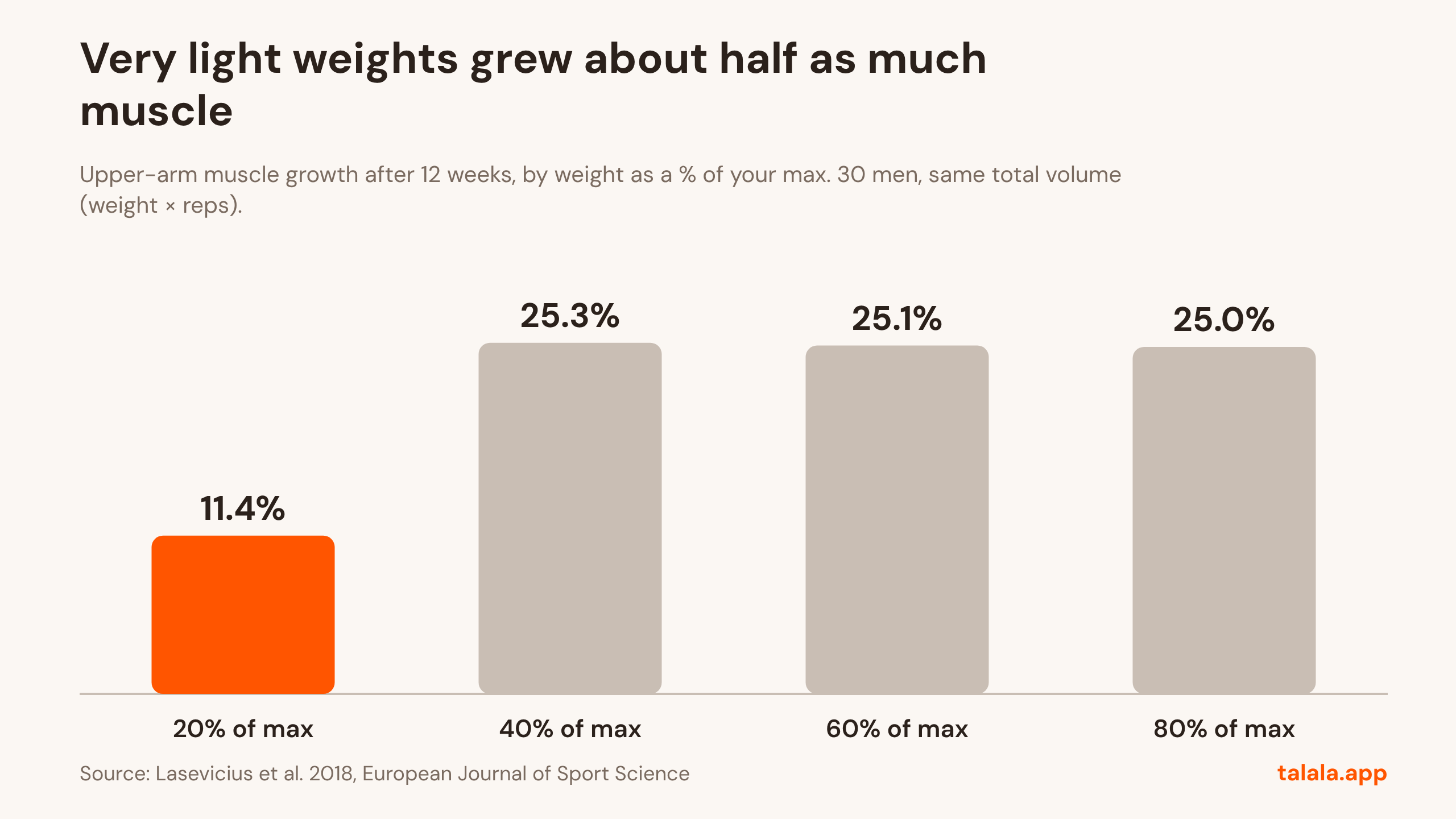
Really light weights seem to come up short even when you push hard. In a 12-week study of 30 men, each person trained one arm and one leg at 20% of their max and the other side at 40%, 60% or 80%, with the total work matched. The 20% side went to failure every set and still grew about half as much: 11.4% in the front of the upper arm, compared with about 25% at the heavier weights.
So I'd treat about 30% of your max as the floor. If the most you could shoulder press once is a 20-pound dumbbell, 30% is 6 pounds.
In a lot of sculpt and toning classes you're moving fast with light dumbbells, which is fun and gets your heart rate up, but the weight can be too light for the set to ever get close to your limit.
Will heavy weights make you bulky?
Not by accident. You'll build some muscle, that's the whole point, and women build it at about the same rate as men relative to where they started. A 2020 meta-analysis comparing men and women on the same programs found no real difference in relative muscle growth, and women actually gained more relative upper-body strength.
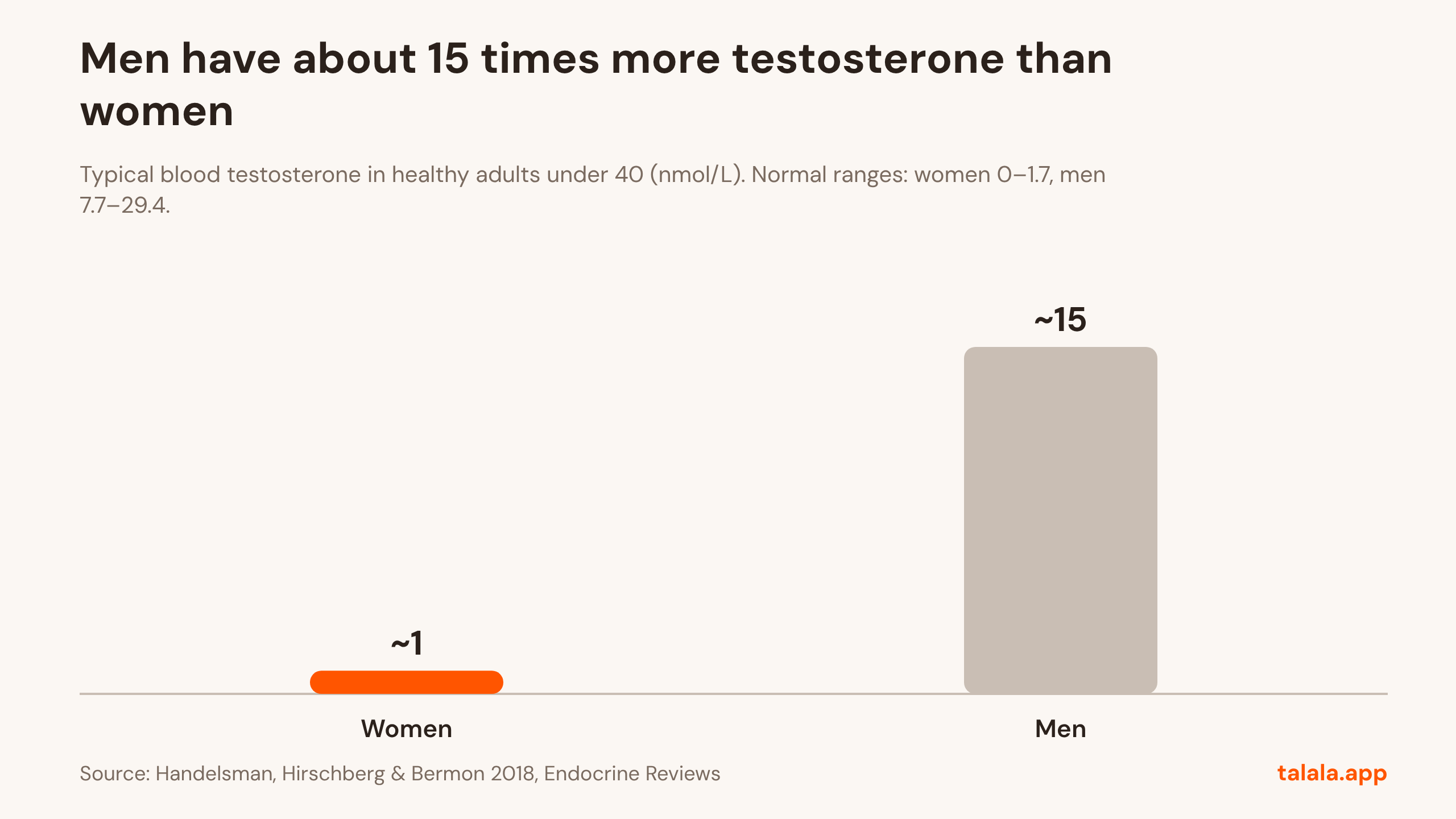
That's relative to where you start, though, and men start with way more. From puberty on, men's testosterone runs more than 15 times higher than women's, according to a review in Endocrine Reviews, and testosterone goes hand in hand with muscle mass. So you're adding to a smaller starting point, and it happens slowly.
If a muscle's growing more than you'd like, you can just keep that weight where it is. And if how much of your muscle shows is part of the goal too, we wrote a guide on how to keep muscle in a calorie deficit.
How do you pick the right weight?
I'd use this test. Pick a weight where the last 2 or 3 reps of a set of 8 to 12 feel hard, your form still looks like it did on rep one, and you could maybe squeeze out 2 more if you had to. If you get to 12 and feel like you could do 10 more, go up a little next time.
Then every week or two, add a rep or a bit of weight. Trainers call this progressive overload, and all it means is asking your muscles for a little more over time so they keep changing.
You can use both in the same workout, too. I'd split it up like this:
| Move | How I'd load it |
|---|---|
| Goblet squat, hip thrust, one-arm dumbbell row | Heavier, 8–12 reps |
| Shoulder press, step-up | Heavier, 8–12 reps, or a bit lighter for 12–15 if form starts to slip |
| Lateral raise, triceps pushdown, band work | Lighter, more reps, until the last 2–3 are a struggle |
Figuring out that weight on your own is mostly guessing, and it's a big reason we built Talala, the AI personal trainer app. It gives you the exact weight, reps and sets for every exercise, and your coach talks you through each set, including how it should feel. Not sure whether to go up? You can ask your coach mid-set, even if you think it's a dumb question.
If you'd rather have the whole thing planned for you, here's how Talala does it.
When do light weights make the most sense?
Light weights are great when they're what you've got. In the same ACSM review, training with elastic bands grew muscle compared with doing no exercise, so a hotel room or a living room with a few bands works fine. You just need more reps to make the sets hard.
They also help when something's sensitive, like a knee or a shoulder. You can tell your coach in Talala, and your coach can leave that area out or keep an easier version of the move with a personal note on how to modify it. If something feels off mid-set, ask your coach how to change it right then.
If you'd like to get stronger too, heavier weights (around 80% of your one-rep max or more) built strength best in that ACSM review. Our guide on why you've stopped getting stronger goes into that.
FAQ
Are 5-pound dumbbells enough to get toned?
For some moves, yes. The sides of your shoulders are small, so 5 pounds can feel heavy pretty fast. Your glutes and legs are way bigger, and 5 pounds won't challenge them much unless you do a ton of reps, so I'd go heavier there.
How many reps should I do for toning?
Anywhere from about 8 up to around 35 reps can build muscle, as long as the last few reps are hard. In that 2015 study, the light group did 25–35 reps and the heavy group did 8–12, and muscle grew about the same. I'd start with 8–12, since it's quicker and builds more strength.
Do I have to go to failure with light weights?
Not every set. In the ACSM review, stopping with about 2 or 3 reps left in the tank was enough. With light weights it's easy to stop way too early, so I'd count how many more you think you've got before you put them down.
How do I know if my weights are heavy enough?
They're heavy enough if the last 2 or 3 reps of each set feel hard and your weights or reps keep creeping up every few weeks. The mirror's kind of a bad judge week to week, so I'd trust those numbers more. In Talala, your coach is with you every step of the way, talking you through every set and motivating you, so you're never guessing on your own.
Can I keep my sculpt or Pilates class?
Of course. I'd keep it and add strength days where the weights get hard. If your week's already full, I'd swap one class for a strength day before adding a whole new day. Our guide on how often women should strength train gets into the schedule.
Obviously I'm not your doctor, so if something hurts or you're postpartum, check with a doctor or physio first.
Talala is where your plan is only yours
Made by women, made for you, backed by science
- Get a workout plan built around your goals
- AI coach led workout sessions, never feel confused about the gym again
- Your coach with you every step of the way, keeping you motivated
Meet your personal trainer: every workout planned for you, and coached in your ear. Download Talala on the App Store